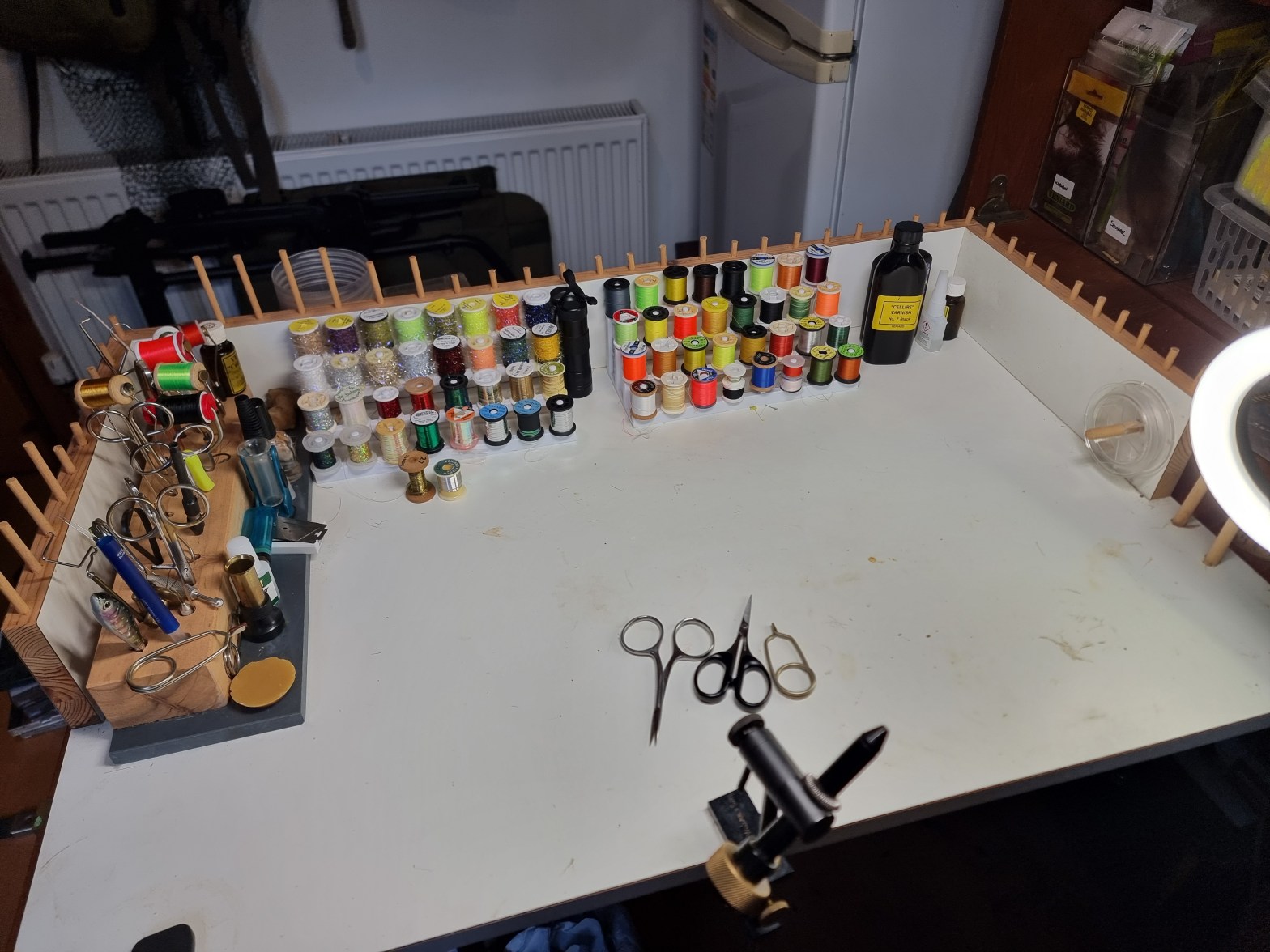
Now that autumn is upon us I thought you might like to see how my fly tying set up is arranged. I am exceedingly fortunate to have a room in the house dedicated to my angling and fly tying gear, something I am sure will turn many of you green with envy. The fact this room is barely able to contain all my gear is a sad reflection on how I have spent a lifetime gathering a huge trove of fishing tackle, most of which rarely sees the water these days.
More over, I am blessed to have a partner who understands that I need plenty of space for my pastimes. Being an artist, she too requires a lot of room for all her materials, so we turned another room in the house into a small studio for her. I fully appreciate that most people do not have the space I do (or such an understanding partner!) and will have to adjust their set up to utilise whatever small nook they can find in the house or flat.
Just to set the scene, way back in my youth I tied on a semi commercial basis, supplying flies to local tackle shops and directly to a small clientele of anglers back in Scotland. That led me to buying materials in bulk and for many years I dealt with Veniard, acquiring everything ay wholesale prices. If I had known then what I know now I would have stocked up even more! The result is that I have a lot of excess materials now, too good to throw out but it will take many years to use up even a fraction of my stock. As always, the high usage materials have been consumed while slower moving items will likely never all be used. I can never have enough bronze mallard, but my large bag of fluorescent pink marabou is not going to be in much demand over here.
A lot of materials and hooks are pretty much redundant these days as a direct result of the collapse in Irish salmon fishing. As I, and many others, abandon fly fishing for Atlantic salmon the requirement for me to tie lots of flies specifically for them has all but disappeared. Boxes of salmon irons, brass and aluminium tubing, bucktail and large hackles are of limited use to me now but I’ve held on to them all so far. Perhaps some of it can be used for making pike flies?
I have previously shared a photo of my old fly tying desk which has been in my possession since I was in my mid-twenties. It is a cupboard with a fold down table, ugly in the extreme but perfect for someone storing materials and making flies. I lost count of how many times this cheap piece of furniture has been moved from one place to another or left in storage in someone’s garage while I went to study or moved to another town. All of this has taken its toll and it looks pretty worn out at this stage, it still does what I want and hopefully it will see me out.
Lighting is hugely important and I have settled on a large overhead LED lamp with a small one set up to shine on the vice at a lower lever. These days you can buy LED lamps for next to nothing so I may buy another lamp to better illuminate the fly in the vice if I go down the road of videoing in the future. I made a board from white faced particle board and this gives me a nice clean backing which reflects light and makes tying much easier. My vice is nothing special, just a bog standard one from Veniard which does all I require. I never got on with free standing vices and I always use one which I can firmly clamp to the table. I store my tools in a homemade stand, roughly fashioned from a piece of scrap timber with holes drilled into it. Threads and tinsels are on a pair of cheap plastic stands and another offcut of timber with 10mm holes drilled in it is where completed flies are stored in clips while the varnish dries.
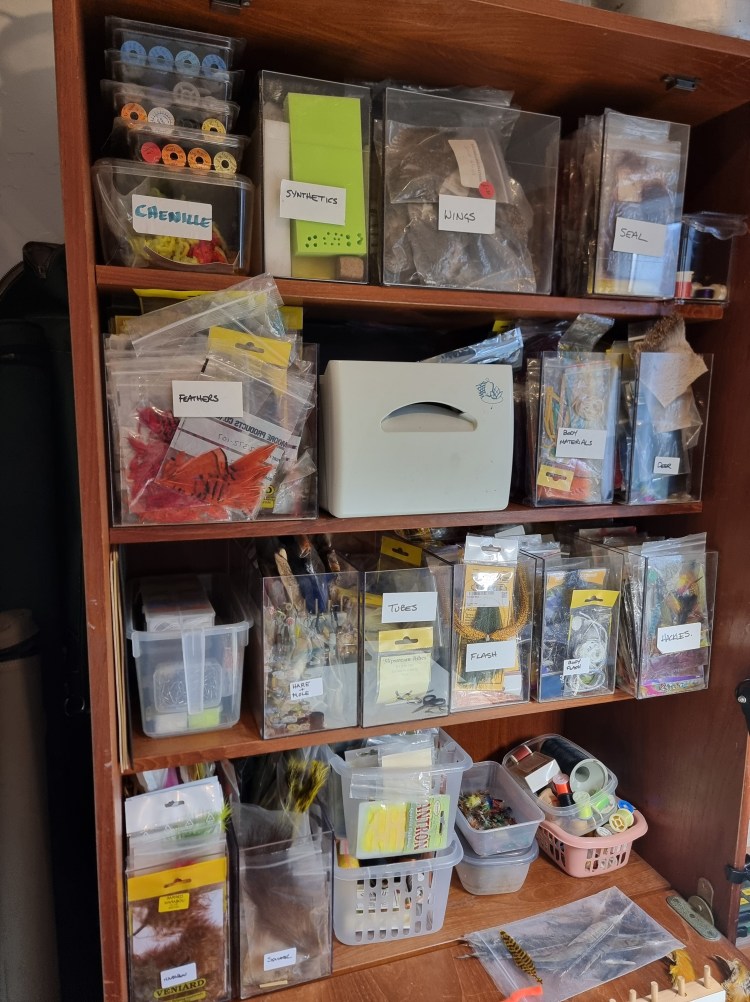
After various different combinations I finally settled on the following arrangement of the materials. Two shelves under the table are home to four large plastic bins which hold bags of bulk materials and dyes. The idea is that as I use the stuff in the small packets in the top shelves and I can top them up from the bulk bins underneath. In day to day tying I rarely delve into the bins, but when I am tying a lot of flies I find myself dipping into them quite often. They also contain large and exotic feathers which are not much used but are stored out of sight. Turkey tail, peacock, heron and the like are all packed away in one bin for example. Whole skins are in another. The bin with all my dyes only comes out once or twice a year when I go mad and do all my dying in one fell swoop.
Many years ago I had a short contract working for a manufacturing company in Dublin. There were some pieces of scrap polycarbonate lying around and as a favour I got one of the guys to cut and fold some containers for me. I had them made so they could accommodate the normal sized polyethene packets my materials were stored in and at the same time were sized to fit into the cabinet. This worked out really well and with some minor adjustments I still use this system today. Wee sticky labels on the ends of the ends of the boxes let me see at a glance what each contains.
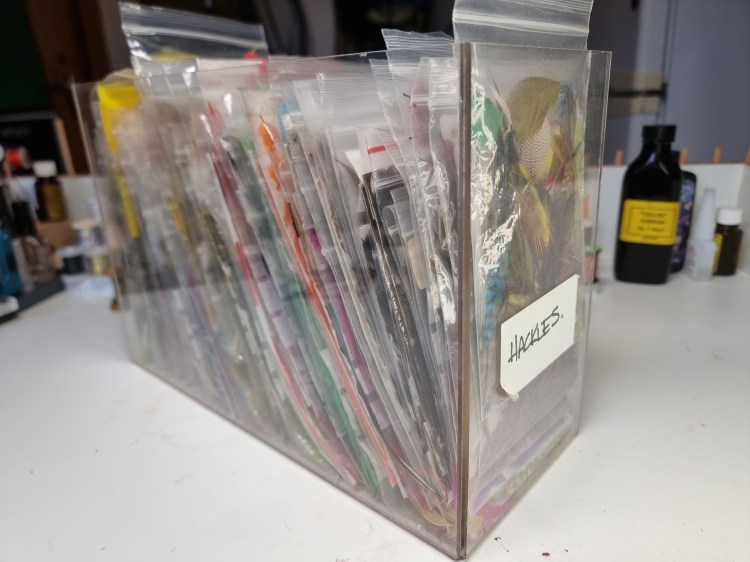
So what is in all these polycarbonate boxes?
- Hackles, this is a mix of all sorts of hackles, cock, hen and game, each sealed in their own small poly bags. I try (unsuccessfully) to arrange them in some sort of order by colour and type to make finding the ones I want easier
- Seal’s fur. I use this material a lot, so one box is dedicated to the various colours
- Wings. just pairs of wings. These are bulky and take up a box on their own
- ‘Feathers’. A bit of a catch all this box, stuff like golden pheasant, jungle cock, goose secondaries, CDC and anything else that I can’t be more specific about
- Flash. Lots of various hanks of krinkle flash and other synthetics for wings and tails
- Body flash. This is the fritz and flashy dubbing box. Not much used these days and most of what is in here is very old, dating from my time tying lures for rainbow trout fishing back in Scotland
- Deer. I love a muddled head on a wet fly, so I have a lot of deer hair in various colours
- Squirrel. Again, self explanatory. Various dyed and natural colours for hair wings
- Bucktail. From my salmon fishing/fly tying days. This is actually stored in an old plastic drawer salvaged from a knackered fridge which was being thrown out and it does the job perfectly
- Tubes. Another throwback to when I lived for salmon fishing. I used to tie hundreds of tube flies and I still have lots of tubing in various materials
- Synthetics. Assorted dubbings, either purely synthetic or blends of different types and colours
- Furs. Here live the skins of small creatures for dubbing; hare, rabbit and mole amongst others
- Foam. Blocks and sheets of coloured foam and the tools for cutting it
- Chenille. Again, not much used these days but I had bought in bulk back in the day when I was doing a lot of rainbow fishing and thus tying lures with chenille bodies
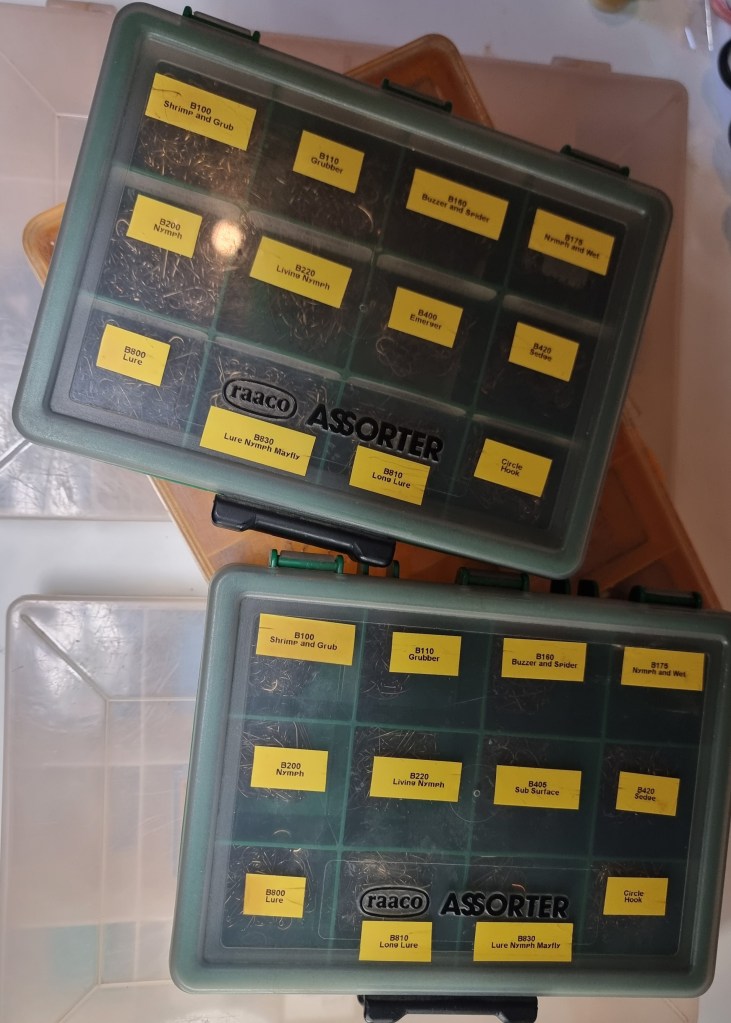
Other boxes are stacked alongside in the cupboard. These store items like spools of tinsel and silks, packets of legs, various beads and such small bits. Hooks are something I get anal about and there are thousands stored in sectioned boxes. The majority are trout hooks but there is a large stock of assorted salmon hooks too. The most commonly used trout hooks are in two small green ‘Racco Assorter’ plastic boxes, one for size 10’s and the other for size 12’s. These are kept close to hand to save me rummaging about for them.
In addition to all of that there are two further clear bins which live on the floor behind my chair, one for cock capes and one for hen capes. Each cape is stored in its own clear poly bag, but I have to say I could be doing with a better system for storing capes. Currently I have to rummage around in these bins to find the cape I want, a waste of time and effort for me. I did try making internal dividers to help segregate different capes but that failed miserably and just made things worse. Afraid you won’t find any of those €120+ capes from the leading USA supplies in my stock! I could never justify such expense to myself, no matter how wonderful those incredible hackles are. I get that each long hackle provides for many flies, and that years of breeding have gone into producing those tiny, stiff barbules and the perfect delicate shades, but my flies are mainly for chucking into white-topped waves on Irish loughs where such perfection is simply not required. There are a few good capes bought at discount prices over the years but the vast majority are cheap Indian or Chinese ones.
As I stated earlier, I have much more materials than the average tyer would own, due to my past commercial tying. I think it is also a reflection on the way I used to fish for salmon mainly and all that I required for those patterns and is largely unused these days. In reality, more than half of the materials and hooks I own could be sold off and I would not miss them. I hold on to it all in the vain hope our salmon fishing will miraculously recover and I can get back into making the flies and fishing for those enigmatic fish.
Like everyone else, I have seen the prices of materials rocket over the past few years. Even the most basic of hackles and hooks are now expensive, so any notion that we are saving money by making our own flies is a total fallacy. I am damn lucky to own the huge trove of materials that I do, allowing me to tie pretty much as I please despite being retired. By far my biggest outlay is hooks, I am forever buying the common sizes of hooks to keep my stock topped up. When tying commercially, I bought them in boxes of 1,000 per size, but these days it is usually a small box of 50, or if I am feeling particularly flush, I might stretch to a box of 100.
Nothing in this world is perfect and this set up is certainly far from perfection. Having said that, it meets my requirements and I spend many, many hours sat at the vice every year. My ancient record player is next to me along with my collection of blues/prog rock/folk/classical albums and I while away the winter days in a little bubble of fly tying to the sounds of my early life. A typical winter sees me tying between 1,000 and 2,000 flies. I would argue there are worse ways to whittle away your time when the wind and rain means you can’t get to the lough or river.


So inspiring to see your set up and also that you use a simple vice. I’m so sick of the fishing magazines becoming catalogues for ridiculously priced and unnecessary crap. My brother and I both tied for years with a very small beginners kit that we shared. I recently saw a base for a vice being offered for several hundred pounds – I despise the commercialism around fly tying and fly fishing! That a skilled tier like you Colin, keeps it simple and avoids all the flashy crap is a breath of fresh air, well done and thanks.
LikeLike