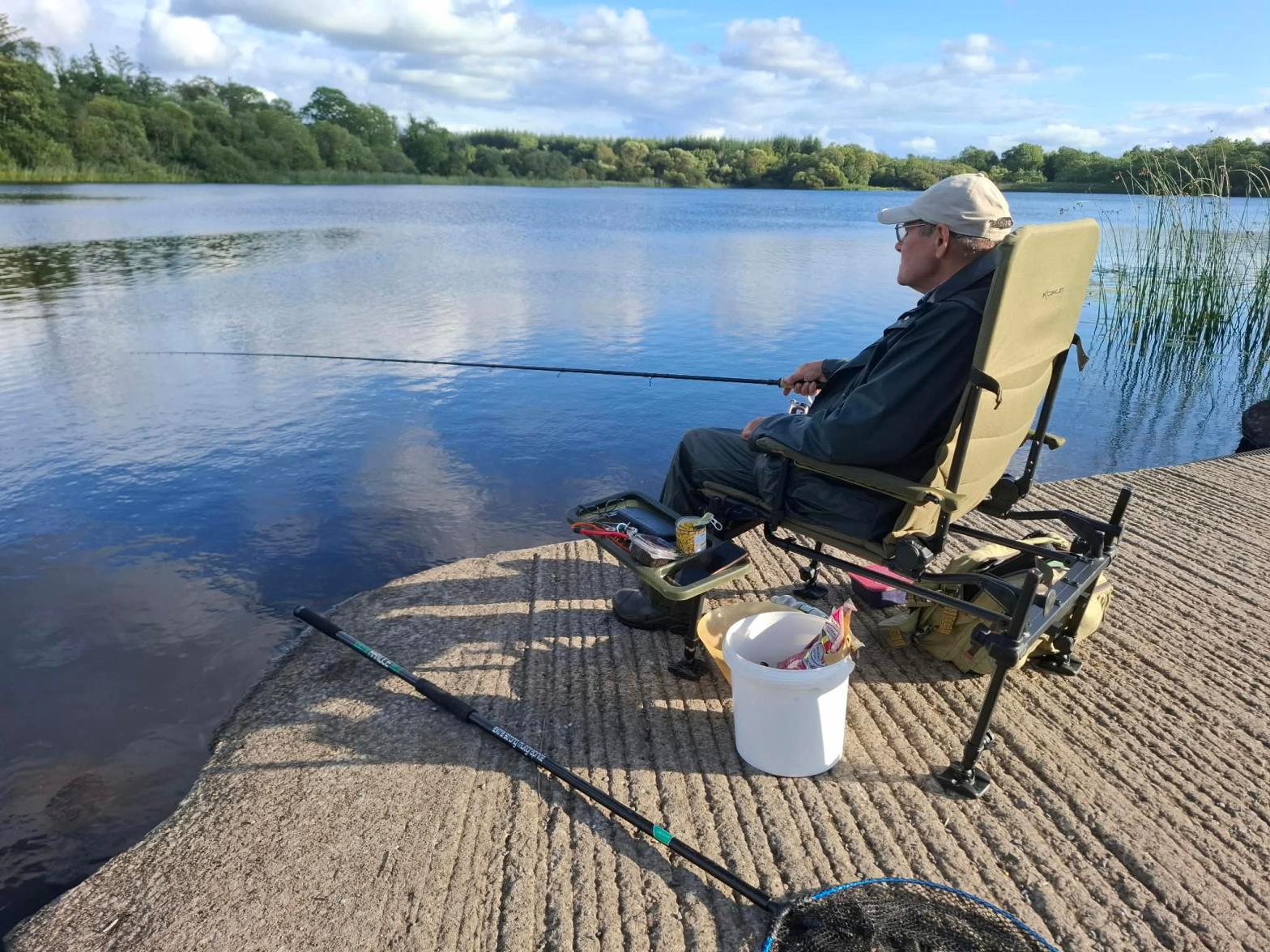
Safety notice – those of a nervous disposition should be aware my ugly mug is plastered all over the following post.
The simple act of writing posts for this blog has many advantages for me. I enjoy mangling the English language in an attempt to tell wee stories of my fishing trips, it stretches my enjoyment of the sport beyond just the time on the bank, it gives me the chance to reflect on tactics etc and, most importantly of all, it allows me to interact with fellow anglers. Those interactions vary from one line comments to meeting up and going fishing with a few of you readers. That’s how I met Nik and we now do a bit of fishing together from time to time. He is based in the far end of County Galway where he fishes a private lake out in the middle of nowhere. Somehow he gained permission for me to fish as his guest yesterday evening, so here is how this little adventure played out.
The drive south was uneventful and I parked up near the water close to 4pm on a slightly blustery summers evening. A high bank behind us prevented said wind causing any problems, and if anything it helped when casting the float. Thankfully it would remain dry during the entirety of the session, a change from the soaking I endured on my last outing to the Erne. Although most of my gear and clothes had dried out there was still an inch of water in my coat pockets, which I found when I placed my phone in one of them. By the time I had set up my gear Nik had arrived, complete with a pole. He placed me in the prime position on the very end of the concrete slipway and explained he had pre-baited the swim in front of me a few hours ago. Confidence was high there would be some fish rooting about on the bottom by now. When I say ‘fish’, I specifically mean bream. This small lake supports a good head of skimmers/bream as well as some rudd and bream/rudd hybrids. Apart from those species there is a very small population of perch and a few pike which grow to a decent size. But it was the bream we were both targeting on this late summer evening.
I had brought maggots and some worms, plus corn as a back up, but Nik recommended I start off with corn to avoid being bothered by the small rudd which would inhale maggots every cast given the chance. So it was that I set up the Diawa 13 footer with six pound mono main line to a four pound hook length and a barbed size 12 hook. The float was a 5BB waggler with bulk shot six inches above the hook and one shot mid way between the bulk and the float. Now this is where things get tricky – what depth should I fish at?
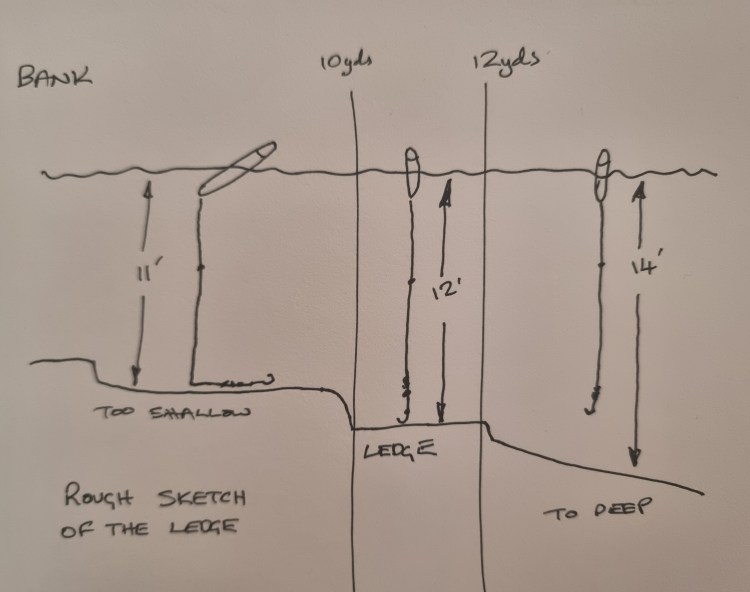
From the diagram you can see there is a ledge about three rod lengths out with about 12 feet of water over that ledge. I set up so that my hook would be on the bottom of that ledge and commenced fishing. Nik cleared a space in the reeds off to my left and set up his pole, his aim being to fish that same ledge but a bit further along from me. I will cut to the chase and tell you that Nik caught way more fish than I did, partly because he is an excellent coarse angler, but also because he was able to put his baited hook exactly where it should be with the pole. I, on the other hand, took a long time to figure out I was not hitting the ledge every cast and even when I did, my bite conversion ration was abysmal. Let me put some flesh on those bones for you.
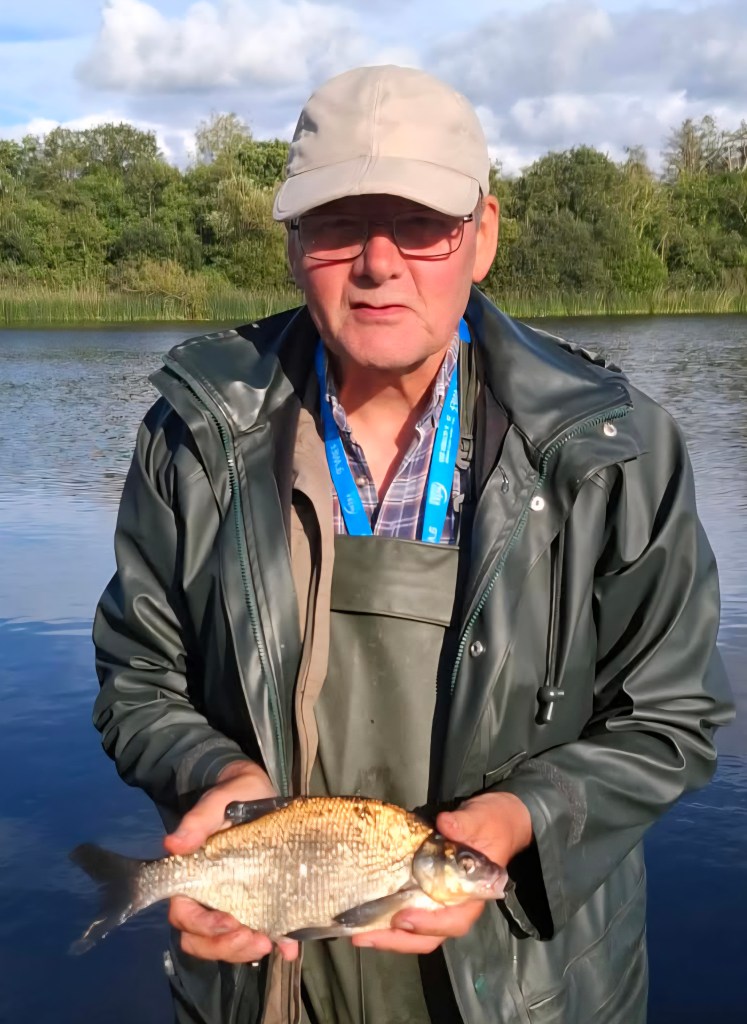
Within the first few casts I picked up a skimmer, and a small rudd, so that gave me a bit of confidence I was doing things right. Nik got going and a steady stream of skimmers and bream came to his net, fish between a pound and a bit under the three pound mark. Both of us were using corn as hook bait. I was finding there were long spells when I was either not getting bites, or when the float did move I failed to set the hook on most occasions. Nik had to nip off for a few minutes to attend to something at home, and while he was away I changed from corn to worm in an effort to improve my hook ups. This had an immediate effect and a nice skimmer of better than a pound came to the net. All thoughts I had cracked the code quickly evaporated as Nik started hauling in good bream at virtually every chuck when he returned, while I was plagued with small rudd. I did manage one nice bream during this spell.
It took my befuddled old brain an age to figure out where I was going wrong. In all probability I was casting too far and my baited hook was not on the bottom as I thought it was. Instead it was over deeper water, above the heads of the bream hard on the bottom. Once I clocked this schoolboy error and corrected my casting I started to get more bites. I was reeling in one small skimmer when the rod buckled and a big fish splashed in front of me. A pike had grabbed the skimmer of course, and for a minute or two I was playing a heavy opponent. Essox didn’t show after that initial splash and the inevitable happened when he sheered through the thin nylon hook length and made good his escape. A new hook length was soon tied on and I was back in action quickly, this time with a size 14 hook.

While the depth was one issue, my striking was also a cause for concern. I am used to roach and hybrids. Fast bites with rapid dips of the float require an immediate response from the angler and that is how I am used to fishing the waggler. Bream are more cautious, the float moves slowly, less deliberately and bites can take longer to build. For most of the evening I was pulling the hook away from the bream before they had properly taken the bait. Again, this took me an age to see the obvious. Can I jut add that I was not sitting there deep in thought trying to figure all this out. No, instead I as doing important stuff like watching the swallows swooping over the lake, taking in the multitudinous shades of green around the water where thick beds of reeds and lilies butted up against throngs of shrubs, bushes and trees. Then there were the clouds in their infinite forms to be studied as they drifted across the blue heavens. It was intoxicating to be there amid the glorious cavalcade nature presented to us on this Irish summer’s evening. I suppose what I am saying is I lacked focus as much as technique, but that is not a crime (not yet anyway, but who knows the way this world is going).
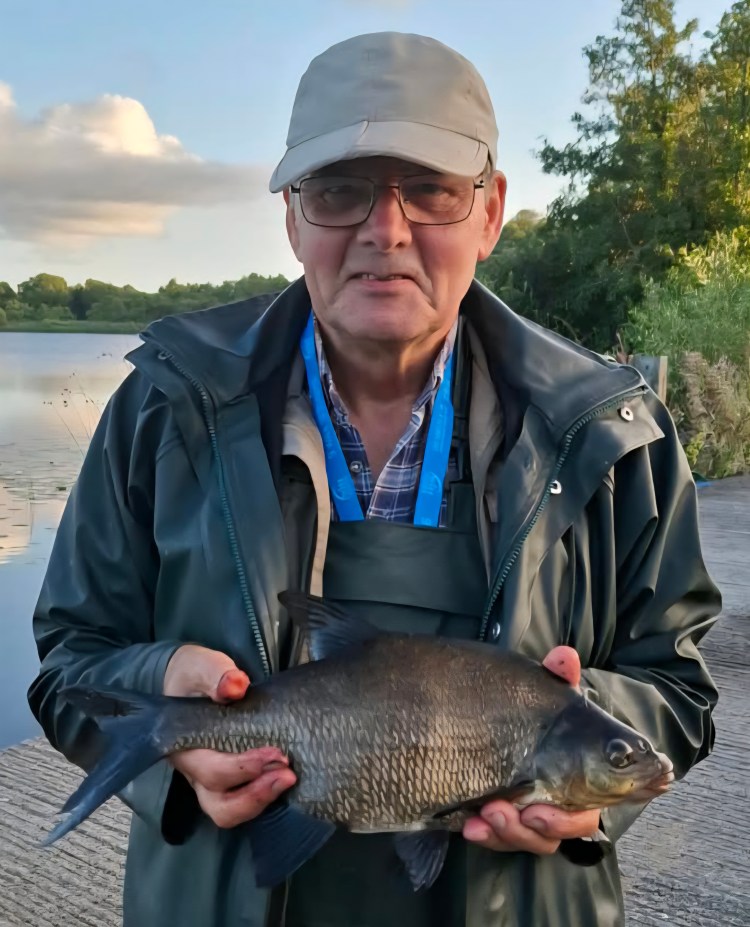
Nik had switched to the worm when I did, but he switched back on to corn, or corn with a worm, for the last half an hour. I stuck it out with the worm, taking more rudd and another skimmer. Looking at the mobile I decided to have one last cast before packing up. This time my float fairly shot under, by far the most positive bite of the whole session. I lifted into a good weight and soon had a lovely dark coloured bream in the meshes. I didn’t weigh the fish but I’d hazard a guess it was close to three pounds.
At just after 8pm I broke down the rod and packed up. Three bream, four skimmers and nine small rudd was my total, but Nik had at least twice that figure. The pole was a huge advantage on this particular water, where the ability to accurately drop the float in exactly the same spot time after time was obvious. Nik deftly shipped bream after bream to hand or net, making it look easy but I am guessing it takes practice to operate a pole so smoothly. I am still not tempted to invest in a pole, it’s beyond me financially but also I have another (smaller) investment to make in the shape of a whip. A sort of halfway house between rod and pole, I want one for the winter roach fishing which is looming ever closer.
The poor old bream gets a lot of bad press, its dour fight and slime covered skin putting many anglers off fishing for them. I view them differently and thoroughly enjoy trying to catch these sad faced creatures of the lake bed. They offer a different challenge to my usual fare of roach and hybrids, a change of pace if you will. They grow to a big size and require planning and organisation to catch them. So what is not to like about staring at a float on a warm mid-August day as the swallows whirl around, waiting for the next slow dip and that heavy tug as the hook finds purchase, twelve feet below in the dark green water?
Many thanks to Nik for the invite and also taking the snaps you see. While we were chatting we even discovered we used to work for the same company twenty odd years ago, he in their Galway plant, me in the satellite factory in Castlebar. In a further twist of fate, he met his wife at work and I first bumped into Helen at the Castlebar plant. It surely is a small world here in the west of Ireland!


That was a great days fishing between two very accomplished piscators. The lake looked lovely from what I could see of it in the pictures. Some good Bream as well. It must have been nice to be catching pure Bream. Hybrids just don’t sit right with me, and the way they are spoken of with such impunity like they are a legitimate species just adds to my disdain. The occasional Roach x Bream hybrid I would have no problem with as a point of interest, but not when they dominate the catch reports. The old fashioned name for them was Pomeranian Bream or pommies in slang which sounds much nicer than Hybrid. Anyway sorry for spouting there. I just saw an opportunity to get that off my chest. There is a reason why Roach x Bream crosses are so numerous here in Ireland, they are a rarity elsewhere in Europe, but I have said enough for now.
LikeLike
Tell me more about the reason why hybrids are more common here, it is something which has been on my mind recently. Some systems (such as the Erne) seem to have a bigger population of hybrids that pure roach.
LikeLike
It’s a very complex issue, but primarily it is due to Bream and Roach being relatively new to Irelands fish fauna. Roach arriving in the early 1900s and I think bream were here a bit before that. Being such newcomers they are competing for the same spawning niches within a waterway, combined with a high degree of overlap with the timing of their spawning due partly to the climate here and the nature of the big Irish waterways taking a bit longer to warm up in springtime, meaning that both species are biologically prepared for spawning at roughly the same time. There is some variation between years which means some years produce more hybrids than others, probably due to the climatic system of a given year. Hybrids were once believed to be sterile, but this has been disproved with female hybrids being found to be very fertile leading to backcrosses eg pure roach x roach-bream hybrid. Triple crosses are not unheard of events.g Rudd x Roach-Bream hybrid. The mind boggles, could there ever be a total collapse of pure Bream or pure Roach due to excessive hybridisation?
LikeLike
I see. On the lower Robe there is a clear separation in the times of the spawning run, the roach come in first followed by the bream a couple of weeks later (all other factors being equal). If the spawning is much closer timewise on other systems you can see why there is such a big overlap, and thus more hybridisation.
I am heading over to Westport now to try and emulate your success with the gudgeon, wish me luck!
Colin
LikeLike
Cool! Hope you get a few. Enjoy
LikeLike