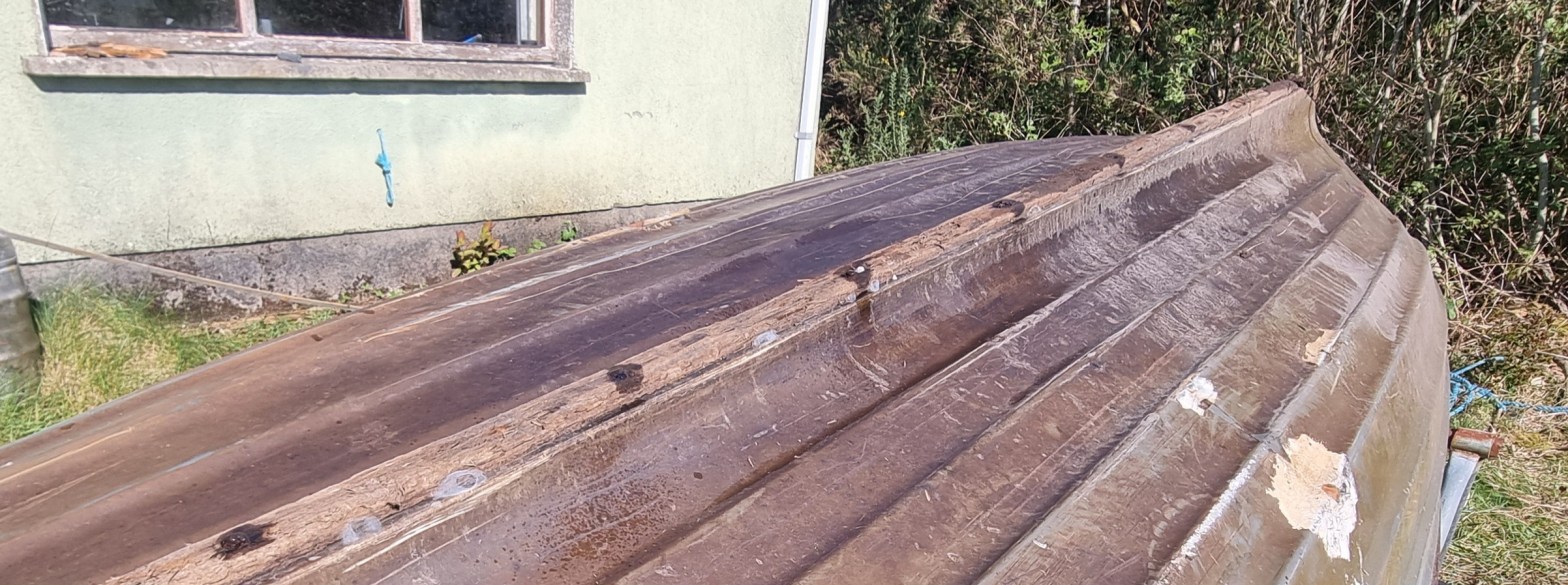
A very quick post this evening. I spent the whole day today working with my mate Ian on repairing my boat and am happy to report she is ready to go back in the water (at last). Last May the old girl was making a funny scraping sound when I was on the lough one day. Pulling ashore that evening I looked around and found the metal keel band had come loose. Thinking it had just shed a screw or two I left it alone but on the next day I was out is quickly became apparent there was a much bigger issue. There was a distinct slapping sound coming from underneath when I was motoring and sure enough, upon close inspection I could see that not only had the metal keel band become detached but the wooden keel itself had partially disintegrated. Nothing else for it, she would have to come out of the water and have the keel replaced. A day or two later I ripped all the ligaments in my left arm and that was me laid up for the rest of the season. Repairing the boat was the last thing on my mind.
I had intended on doing the repairs over the winter but with one thing another the job was put on the long finger. Winter turned to spring and other issues got in the way of my plans but the situation was now becoming critical. Not alone would I be missing out on the fishing but I had customers depending on me and my boat. At this point Ian stepped in and said he would help me out, so the boat was dragged up to his place and left there until he could free up a day to assist me. That day was today!
Normally, two fit people can flip a 19 footer over but my old McAlinden is an absolute beast and it took three of us to topple her over this morning. Once inverted, we stripped off the remains of the rotten and broken timber keel. The majority of the metal band had already disappeared, leaving short sections at the bow and stern. All the screws holding the keel together were rotten and most of them snapped when we tried to unscrew them, meaning the sharp ends had to be ground down. Our plan was the retain the existing metal band on the bow, clean up the end and weld new steel on to this butt. We would do the same at the stern. The reason for this was I was unsure of exactly what was in the hull itself and if we could indeed find solid wood under the glassfibre to screw into.
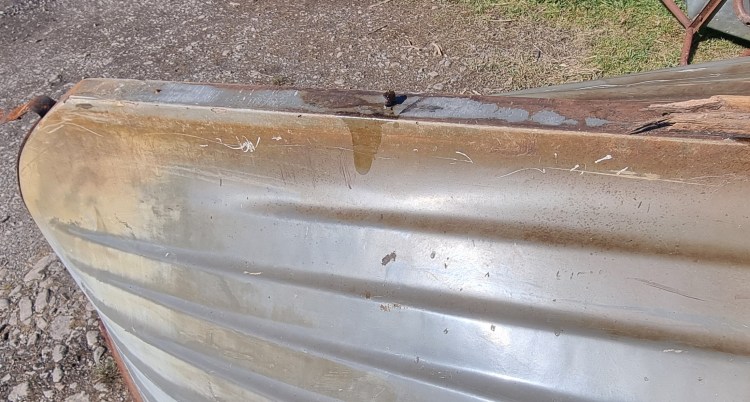
Once the old stuff had been removed we turned out attention to the length of larch I had bought for a new keel. This was the right size for an Anglers Fancy or a Sheelin, but was far too big for my boat. Ian went off and unearthed a table saw from somewhere and we got busy cutting the right height of timber. Next, we shaped both ends with a jigsaw, matching the curves of the hull. A quick smoothing with a belt sander and the the timber was ready. Now it was a trip to the local builders merchants where I bought a 20 foot length of 40mm x 5mm steel to make a new keel band. Back in the yard, we measured up for the right spacings, then using a pillar drill I drilled and counter sunk the holes down the centre of the band. Next, Ian drilled pilot holes and I followed along behind him screwing the timber to the hull with SS screws. At that point we stopped for a well earned cuppa.
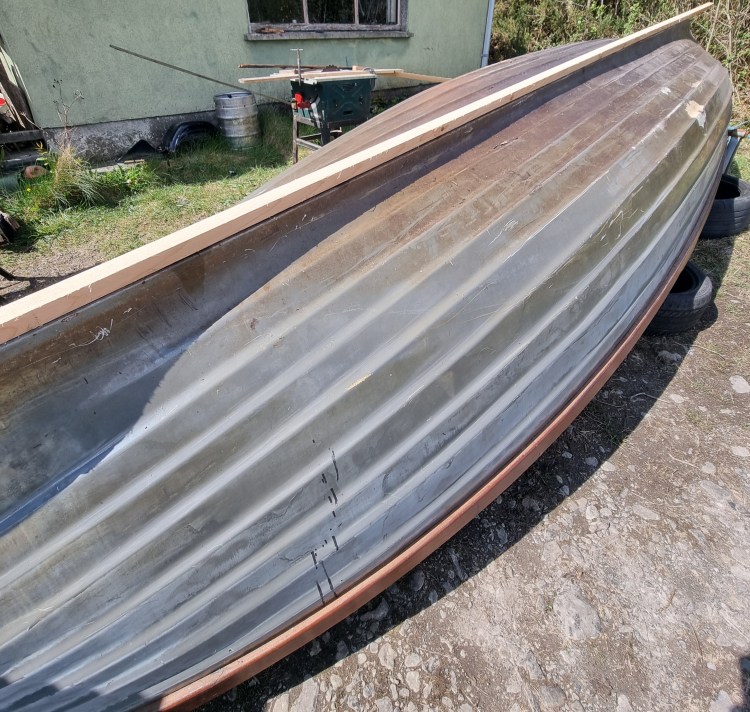
Refreshed, we now had to tackle the biggest part of the job, welding the keel band in place. The stockist on had 5mm steel, whereas the original band had been fabricated from 3mm. You can take it from me, 5mm steel does not like to be bent, so we had to find another way of shaping the steel. This was done by lifting the band up high and me jamming the two ends together with a piece of wood long enough enough to allow Ian to tack the end to the existing band on the bow. This took a couple of attempts but we got there in the end. Some hefty blows with a hammer persuaded the steel into the right shape to follow the curve of the bow. The pre-drilled steel was now laid on top of the timber and screwed into place with more SS screws.
The stern was a challenge as the 3mm existing band was badly corroded and very thin. We got around this by welding a small piece of steel on the the end of the band at right angles, then drilling this tab and screwing it to the hull. Ian did all the welding, I just hung about with bottles of water to cool off the welds and prevent any damage to the hull. We had started at 9.30am and by 4.30pm the job was done. Originally, I was going to carry out this repair on my own but in truth, it would have been beyond me and without Ian’s help it would have turned out badly for me. Anyway, the boat is now fit for use, just in time for the height of the angling season. The last few weeks have been challenging, first the car problems which were only resolved by buying another motor, and then the repairs to make my boat fit for use. Thankfully, these tasks have been resolved and I am hoping for a busy month of May, ghillieing and fishing across the west.


Well done, oak would be my thought, treated and scarfed.
LikeLike
impossible to find hardwood these days, larch is a good substitute but even that is hard to find.
LikeLike