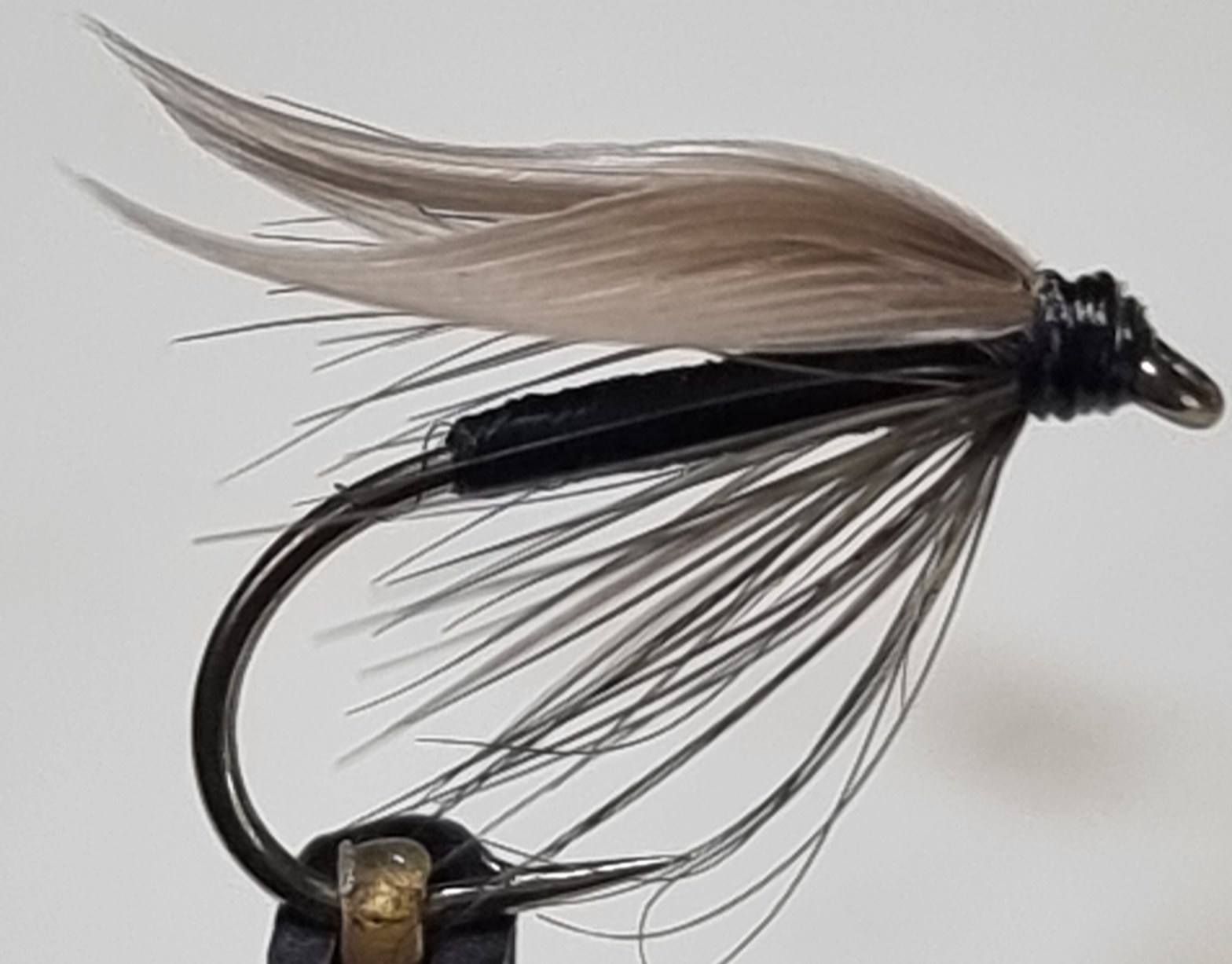
Our terrible weather continues again this bank holiday weekend with storm ‘Dave’ bringing intense rain and high winds to the west of Ireland. I can’t recall such a prolonged period of cold, wet weather even over here where we are no strangers to inclement conditions. The loughs and rivers remain stubbornly high and the fishing has barely started because of this. Normally, I would be reporting on fly fishing on the local rivers or fishing the duckfly on the loughs, but instead I have to content myself with more fly tying.
Surely one of the simplest yet successful flies for river fishing in Ireland, the Black Gnat is found in every fly fishers box. It is a very old pattern, so you just know there are going to be lots and lots of variants to pick from. These days we have a plethora of new patterns to pick from when imitating small dark naturals with everything from Klinkhammers, F fly, Griffiths Gnats and a host of others that do essentially the same job. I use them all but it is nice to tie and use flies like the Black Gnat for old times sake. I see the old winging methods being utilised less and less these days and it would be a shame to see paired wings disappear altogether.
So, what does this wee fly represent? The answer is nothing specific, it covers a wide range of small black naturals which either hatch out in the river or are terrestrial and happen to fall on to the surface. Dressed on larger hooks, say, size 12 or 14, you can get away with using it during a fall of hawthorns. In smaller sizes you can catch a few fish during a fall of black ants. Reed smuts and the host of Diptera species are the most common tiny dark flies the trout feed on and this is where the Black Gnat excels.
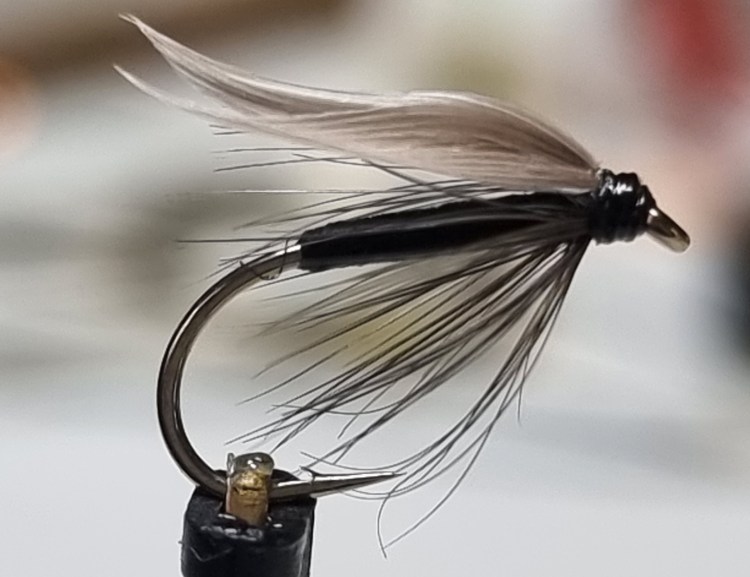
The most basic wet fly pattern consists of a black tying silk body which is unribbed. A black hen hackle and wings made from paired slips of starling or other blae feathers completes the fly, the whole thing being tied on hooks ranging from 12 down to 20. I’ve used this fly since I was a lad and it will catch you a trout from the first day of the season to the last. Sweeping it down-and-across in fastish water in the company of a couple of spiders can be absolutely deadly. If you are unsure of what to begin with then adding this fly to your leader is going to give you a great starting point.
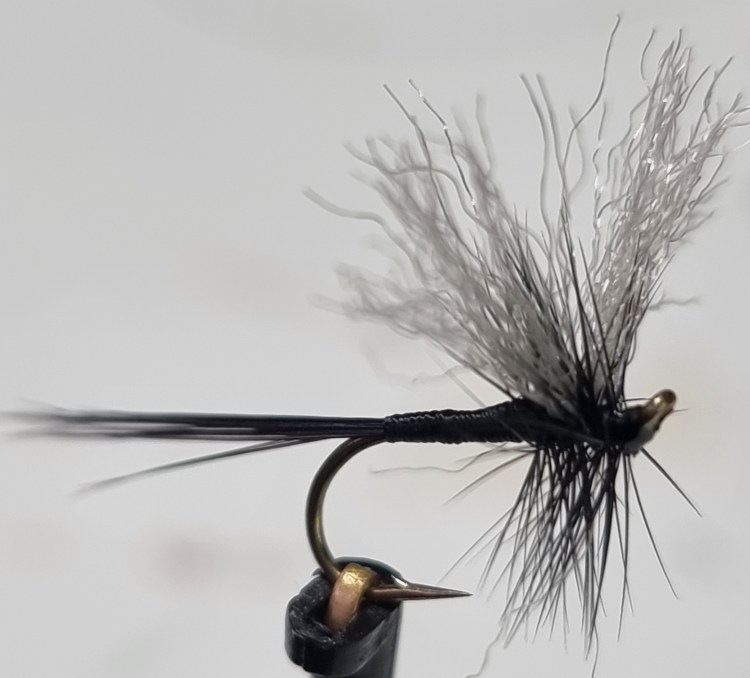
The feather fibre wings are of course subject to damage in use, so replacing the starling with grey polypropylene makes for a much stronger, if less aesthetically acceptable fly. That works on the wet fly but also on a dry version. Here you can tie in the wings upright and in a ‘V’. A cock hackle is best used for the dry versions. I also add a tail made from a few fibres of a black cock hackle to my dry black gnats. I do this simply to help the fly to sit as I want on the surface.
Another variant sports Lady Amherst pheasant tippet fibres as a wing, this time slanted over the back of the fly. This is a pretty wee fly but I am not sure it catches any more trout than the others. Use a cock hackle for the dry version and a wee black hen hackle for the wet one. Look, if you have a few of the white and black barred tippet feathers lying around you can whip up a few of these, they are a nice addition to your fly box if nothing else.
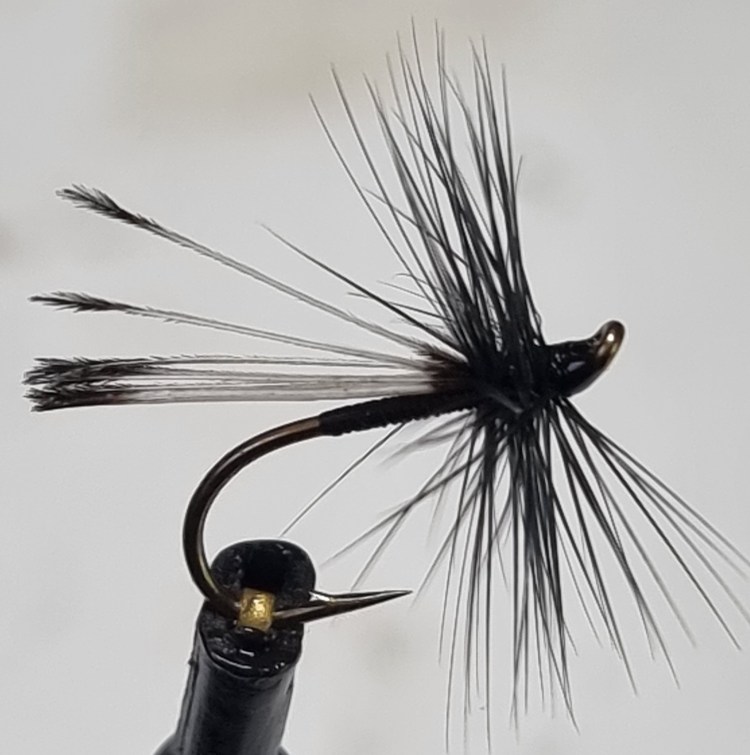
Using hackle points for the wings is another popular option. White, badger or blue dun can all be pressed into service. On a dry fly these can be cocked upright or splayed out in a ‘V’ over the back of the fly. I tie both styles in case the fish are being particularly fussy and want one style over the other. A pair of CDC feathers (grey or white) tied over the back of the fly makes an excellent fly which is very versatile.
In all of these patterns the body is generally black tying silk, and I am fortunate to still have a couple of spools of Pearsall’s Gossamer in my kit. This makes a lovely body which has a very slightly ribbed appearance. Some tyers prefer to add a black dubbing or black silk body. This makes a lot of sense when you examine some Diptera species. Many are slim bodied, but some others are short and stout. A fly tied with a body of dubbed mole fur which has been dyed black is handy to have to hand if the trout are feeding on the thicker bodied naturals. Other black dubbings can of course be used, such as seal or antron.
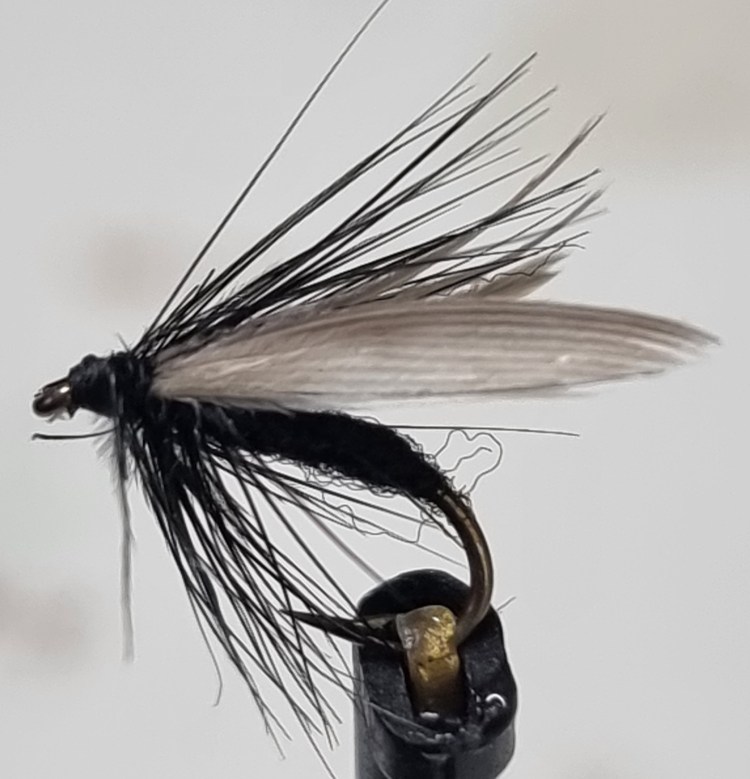
I have been rabbiting on about these flies as if they are exclusively used on flowing water, but in fact they can work on loughs too, especially early in the season. I like to add a wee silver tag to the end of the body if I am using the black gnat on the lake at duckfly time. Being honest, I much prefer a Blae and Black for the lough, but the gnat will work too if that’s all you have in your box.
Fishing the black gnat is a big subject all on its own! As a dry fly you cast it upstream and then dead drift it in the conventional manner. It can be deadly fished in the surface film, and this is where the CDC winged versions really come into their own. As a wet fly, it can be cast upstream or down, either as part of a team or fished singly on a very fine leader. Indeed, when confronted with a tough day and no signs of a hatch on the stream, a small black gnat fished on a skinny leader can often save the day.
I must confess that I have a ridiculous number of black gnats in my own fly boxes. It is such a confidence pattern that I find myself whipping up a few at every opportunity, even though I will never live long enough to fish with all the ones I already possess. This is especially true of the very smallest ones, as being in my late sixties I feel there is a limited time left for my old eyes to allow me to tie tiny flies.

 Claretbumbler
Another fly that I always have in my box Colin. Like where you are it’s been a dismal wet and cold year so far here in North Antrim. I don’t remember a worse one. Things can only get better 🤞
LikeLike
One of the local lads I was talking to yesterday is well into his ’80’s and he told me this is the wettest spring he can remember. We can only hope that when things do warm up and we get a dry spell the fish will come on the feed quickly.
LikeLike
I tied a few winged flies over winter for the first time in ages. Took a few goes to get it right.
LikeLike
bi-furcating wing, curved to outside for vibration, tails can be done this way too.
LikeLike