
I don’t do a whole pile of buzzer fishing. It’s not that I have anything against it, I just don’t enjoy it as much as other fly fishing techniques. There is also the fact it works better on some loughs than on others, Corrib is buzzer central for example whereas it it hardly used on lough Conn. For wild brownies it is a method which I tend to use on tough days when conditions are against me and pulling wets or fishing dry are not working. On put-and-take lakes I use buzzers a little more frequently as I find that rainbows in particular love them. In summary, I use buzzers for very specific conditions and venues but they are not my preferred method of fly fishing. Having said all of that, in common with most other fly fishers I know, I have a box full of buzzers which lives in my tackle bag all year round.
Thousands of pages have been written on the subject of buzzers, most of it by anglers with more experience of the different strategies than me, so I am not going to go into too much detail about the particular methods. For me, finding the right location is 90% of the battle. While buzzers hatch out over vast areas of the loughs you really need to home in on specific ‘duckfly holes’ to maximise your catch. Trial and error is going to be tedious so keep your eyes and ears open for any snippets of info that will guide you to the hot spots. General areas will be in the public domain but on the big Irish loughs that can still cover huge expanses of water. You are looking for water roughly 6 to 12 feet deep and a soft bottom as a rule of thumb.
Once you have found your buzzer hole the most important factor is going to be how slowly you retrieve. You need to do no more than keep pace with any drifting of the boat so your flies are marginally above stationary. The heavy tail fly drags the lighter flies on the droppers down so by having them well spaced you have your buzzers fishing in different levels of the water column. On UK reservoirs anglers anchor up to fish the buzzer but that is frowned upon here on the big loughs.
As for the flies themselves, I think of them in terms of how heavy they are and roughly divide them into three categories, heavy, light and dry.
Heavy patterns
These imitate the buzzer when it is close to the bottom. Older patterns featured weight under the dressing such as turn of copper or lead wire, but these days epoxy buzzers are much more popular.
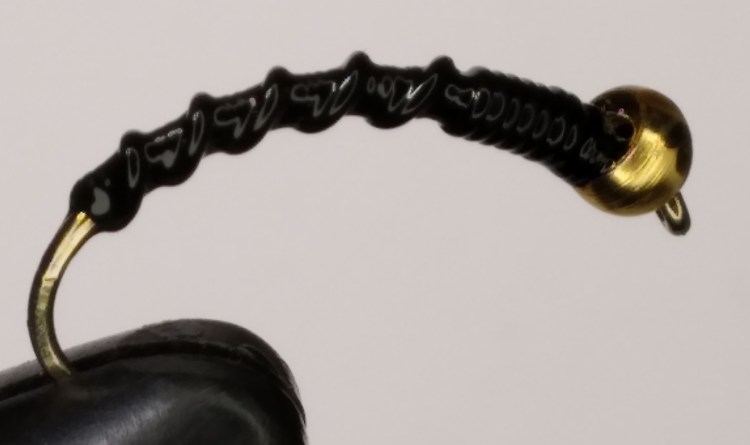
Goldhead Buzzer
Hook: size 10 or 12 heavyweight. These can be straight or curved. In terms of size, it pays to have both larger and small buzzers in your box. Whopping great size 8’s can be good on some day and dropping to a size 14 may equally well be a good move on occasion.
Tying silk: black, 6/0. I like the slightly heavier silk as it builds the body better than skinny 8/0 or finer.
Abdomen: just the tying silk wound well around the bend of the hook
Rib: heavy wire, colour can be varied as required but black is as good as any
Thorax: more tight wraps of the tick wire or you can wind some black floss into a thick thorax
Bead: a gold or tungsten bead, size as required to add weight
The whole fly is then coated with clear epoxy resin and hardened off. More than one coat may be required. Colours can be varied with brown, olive and red all possibilities in addition to the ubiquitous black.
Bloodworm
A very simple yet surprisingly effective imitation of the larvae stage of the insects lifecycle. When you see the natural they lash around in a very distinctive way and the mobile marabou goes some way to mimicking that.
Hook: again, use a size 10 or 12 heavyweight curved hook
Tying silk: red, 6/0
Tail: a tuft of red marabou
Body: red floss ribbed with fine silver wire
Thorax: peacock herl

The Vicar
I know there are many variants of this pattern but they trigger point is the same with them all, that couple of turns of fine flat tinsel at the joint between the abdomen and the thorax.
Hook: sizes 10 down to 14, usually straight shank
Tying silk: black, 6/0
Abdomen: just the tying silk wound to make a tapered shape
Rib: gold wire in open turns
Collar: 2 or 3 turns of flat gold tinsel. You can vary this with other colours of flat tinsel with silver and holographic red being popular
Abdomen: tying silk wound to form a thick blob
The whole fly is then coated with epoxy resin
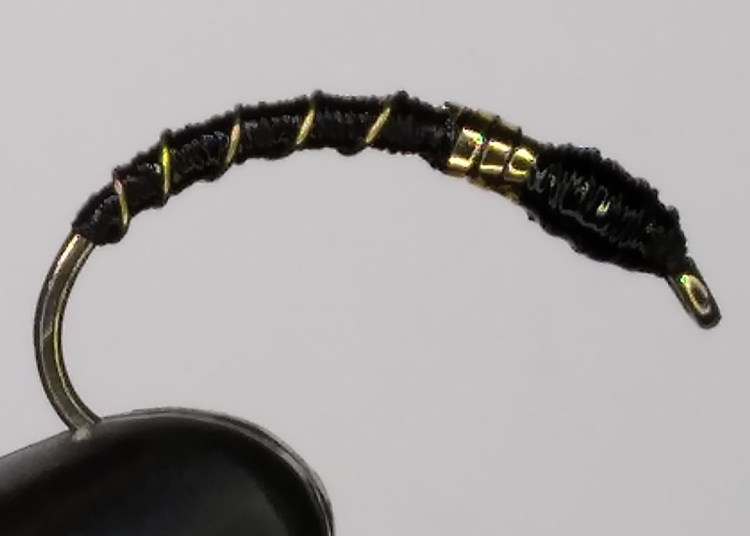
In all of the above patterns I personally believe the thick thorax is very important. Look at natural buzzers and you will see what I mean.
Mid water patterns
These can be fished in so many ways. Obviously they can be added to droppers on a long leader with a heavy epoxy buzzer on the tail to get the flies well down. You can fish them washing line style too. Tie one, two or ever three on to droppers and fish a dry fly on the tail.
Grey buzzer
Hook: sizes 10 down to 14. I prefer sedge style hooks but you can use straight or curved hooks as you please
Tying silk: black, 8/0
Abdomen: Canada goose secondary wing feather fibres
Rib: fine oval silver tinsel
Wings: these are optional, but you can add a pair of badger cock hackle tips
Thorax: bronze peacock herl
Hackle: a couple of turns of badger hackle
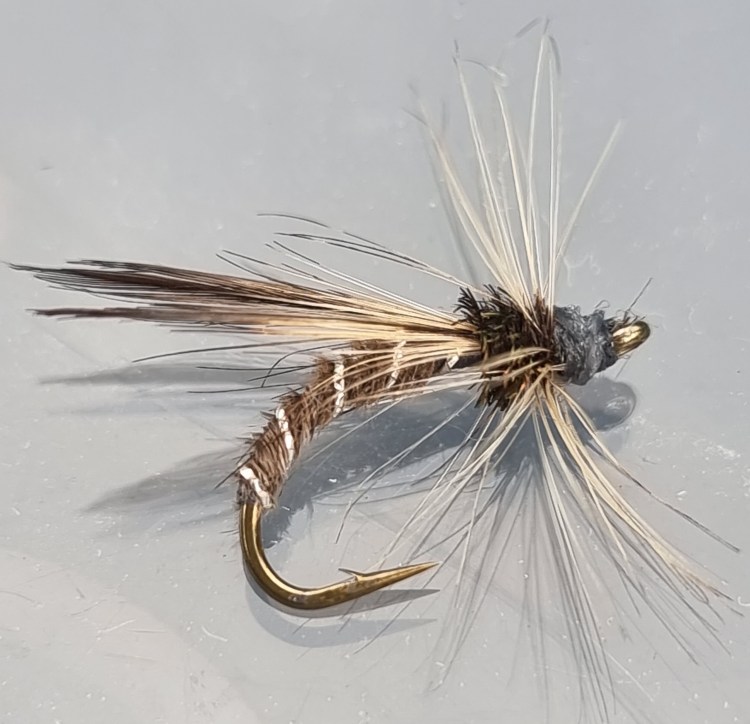
Pearly Duckfly Emerger
This pattern certainly works but I have my doubts if the fish are actually taking it as a hatching insect. When you watch a buzzer hatch out on the surface of the lough you will see it accomplish this feat in an astonishingly short time. Regardless, here is a the fly I use.
Hook: sizes 12 or 14 curved fly hook such as a Kamasan B100
Tying silk: black, 8/0
Abdomen: a single strand of peacock herl, either natural or dyed black
Rib: medium flat pearl with a counter rib of finest silver wire
Wings: a slim wing of natural grey squirrel tail hair, tied short
Thorax: fiery brown seals fur, tied thickly
Hackle: fiery brown cock hackle, 1 turn

Dry buzzers
These can be fished singly on the end of a fine dry fly leader or on the top dropper position of a leader with wet buzzers below it.
Bob’s Bits
Hook: sizes 10 down to 14 down eye dry fly hooks
Tying silk: 8/0 to match the colour of the fly
Breathers: floating yarn, white or similar light colour, tufts sticking out front and back
Body: roughly dubbed fur, usual range of colours
Hackle: not really required but you can wind a couple of turns of a hackle at the head

Top Hat buzzer
Hook: 10 or 12 down eyed hook such as a Kamasan B170 or a curved hook like the B100
Tying silk: 8/0
Post: a piece of 6mm booby cord, cut at an angle to make it easier to tie in
Abdomen: Seals fur
Rib: oval silver tinsel
Hackle: a few turns of a cock hackle wound around the post

Colours for all of these patterns are conservative. Black is by far the most popular and catches an immense number of trout every season. I like brown-olive and grey as well. Reds, oranges, all shades of olive all have their day too so carry a range of different shades.
I see so many different buzzer patterns in the fly boxes of visiting anglers and they speak of great catches on this one or that on the rainbow stocked reservoirs. It sounds like great fun alright, and very different from what I am used to here in the West of Ireland. Where as the lads who fish Chew or Grafham carry lots of buzzers my boxes bulge with dabblers, bumbles and wulff’s. As I say, there is no right or wrong when it comes to fishing, just find the methods you personally joy.

 Claretbumbler
I really like the look of that gray buzzer. The blood worm is nice. I’ve tied those before but never with that much of a tail. Very enticing.
LikeLike
They grey buzzer can be very good indeed! Works well fished on a washing line set up too. The bloodworm looks good in the water, the movement in the long marabou tail goes some way towards imitating the lashing movement of the natural. You can tie a simpler version with just the marabou tail and red flex floss body coated in epoxy.
LikeLiked by 1 person
The thing that baffles me with buzzers/bloodworm imitations is that the ones that work best seem to be so much bigger than the natural.
LikeLike
I know what you mean, but here in Ireland some of the buzzers are HUGE! A size 8 would be a near approximation of some species and 10 is probably the best size if you are not sure what to start with. I think there is also a case of exaggeration of the size helps when there are so many smaller naturals in the water. I am always amazed that some anglers have great success with quite brightly coloured buzzer patterns. I only ever see black, grey or claret naturlas over here.
LikeLike