
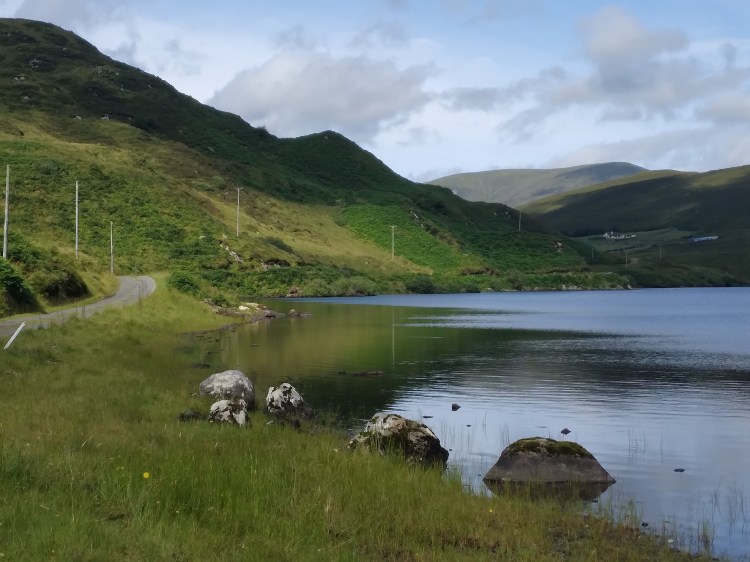
While most of my trout fishing is done on the big loughs from a boat I still try to fit in the occasional trip to the smaller stillwaters dotted around the west of Ireland. These wild fisheries are usually home to small browns where a half pounder is a good fish. I think my favourite one is Bunaveela, way up in the Nephin Beg hills. Here is how a typical day shaped up on this wonderful, atmospheric lough.
Bunaveela is home to one of the last populations of Arctic Char in Ireland. Char live in deep water so I was very unlikely to hook any while casting around the shallow edges of the lough. That’s a pity as I would love to catch one of these enigmatic little fish which have been a part of Ireland’s natural world since the last ice age. Conn used to have a population of char but they have gone extinct, possibly due to pollution or warming temperature of the water in the lake. Maybe I will get lucky one day a catch a char on Bunaveela, but the chances are pretty slim.
The road into the lough links the Newport road to Keenagh and a very entertaining stretch of tarmac it is. Coming from Keenagh Junction it starts off alright with a white line down the middle and all, but you are no sooner past the church when it narrows to a single track where passing places are at a premium. As the road gains height the surface deteriorates to little mor ethan a series of linked potholes, some roughy filled others left as they are. Over the crest of a hill I met a gaggle of cyclists, crimson faced and puffing hard as they came up from the other side. How anyone can call that enjoyment is beyond me. From that crest you get your first glimpse of Bunaveela, laid out like a jewel amid the green of the summer bogland. Most of the hills loughs require a long walk over rough ground to reach them but Bunaveela has the luxury of a road which runs along part of the southern shore. Parking spots are at a premium though and it took me a while to find a patch of ground off the tarmac to leave the car. At last it was time to gown up and get fishing. Thigh waders, a waterproof jacket and a hat are sufficient protection against the elements on a nice day like this one.
Gear for fishing hills loughs is not complicated. I use a 6 weight eleven footer and a floating line. On this occasion I pared the rod with an old but perfectly serviceable Roddy 320 fly reel. Spare leaders and one box of smallish wets are just about all I carry with me. I don’t bother with a net as the fish you encounter on loughs like this will be small. Your standard three fly leader of about ten feet in length is grand and I use 5 pound mono as a rule. As for flies, I don’t think the trout are too fussy and size 12 or 14 lough patterns are my staple offerings. Something black is virtually always on my leader, and the same goes for claret. This time I started off with a black spider dressed on a size 14 hook on the bob, a welsh partridge in the middle and a wickhams on the tail, the latter two being size 12. The edges of this lough are very shallow but only a little way out there is a drop off into deep water so care is required, especially in dull conditions as the you can’t see the bottom in the peaty water and it would be easy to take one step too far.
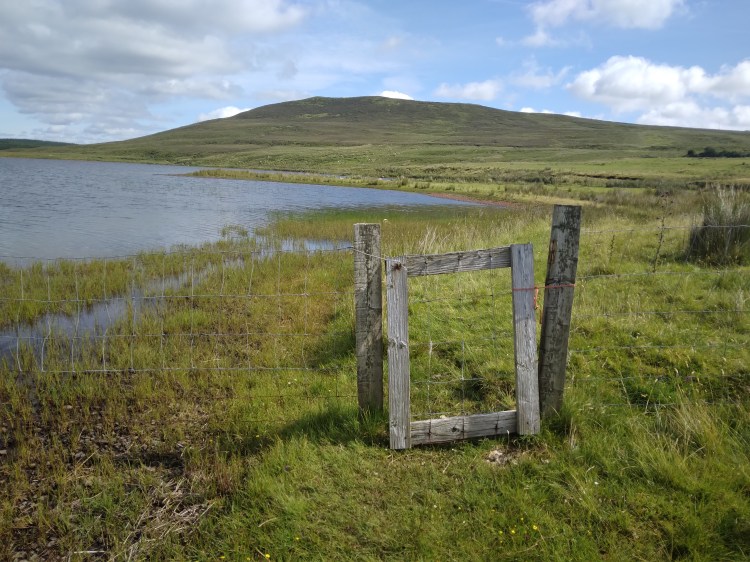
With the wind coming across my left shoulder I started casting, the light rod pushing out a good line and turning the flies over nicely. As is my usual modus operandi, I kept moving so I was always covering new water. For me, this is a vital part of hill loch fishing as the trotu can be widely distributed. Just as I was thinking about changing a fly there was a violent jerk and a fish splashed as it felt the hook. This trout put up one hell of a scrap and threw the hook before I had even seen it. Only that I know what this lough is like, it would be tempting to put that lost fish as well over a pound in weight. In truth, I doubt if it was a half pounder. I checked the flies then started casting again, all the time edging to my right on the firm gravel bottom. Some reeds looked to be a possible hiding place for a fish or two but I got no response despite fishing diligently around them. Back on shore, I went through a rather wonderful gate into the next field and found a small feeder stream. Anywhere you see water coming into a lough is worth a try so I waded out a little and started to cast. Bang! I pricked another small trout almost immediately. These fish take at lightning speed and I was finding it hard to adjust to their bites. I decided to change all the flies, and in their place I tied on a Bibio, a Green Peter and a Dunkled. With these three stalwarts in place I got back to business under a cloud dappled turquoise sky.
As I had come round the shore I was now facing partly into the wind. It was not strong but it did require me to work on my timing when casting to avoid tangles and get the leader to straighten out fully. By now I am fanning may casts across the water directly out from where the stream enters. A small trout leaped int othe air and landed plum on top of my flies, hooking itself in the process. Lifting the rod it was clear something as amiss as there was too much weight on the end to be the fish that I had seen. Soon I could see the issue, a second trout was hanging on to the tail fly. A quick snap then they were back in tea coloured water.
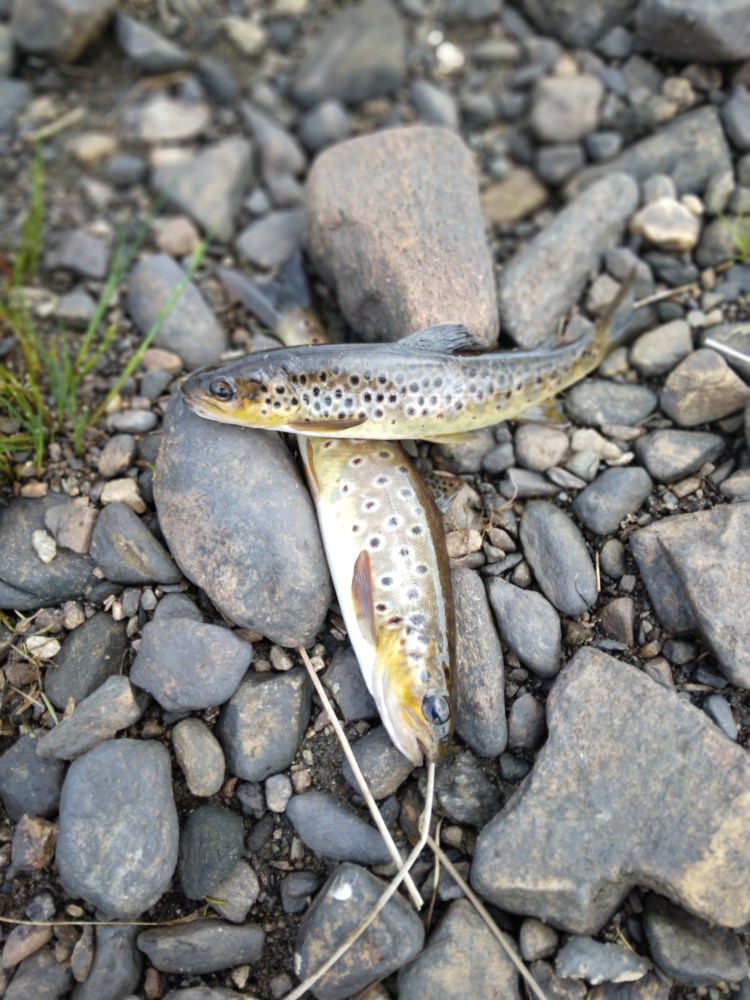
More casts, a rise which I missed, more edging along the red sandstone gravel. I went as far as another fence but decided to double back from there. A long, open bank the other side of the fence faced directly into the wind and the next rocky point was some distance away. As this was only going to be a very short session I did not want to spend the most of it walking instead of fishing, so I retraced my steps to the feeder stream. Another couple of tugs which I failed to convert into fish on the bank followed. Off came the normally reliable Bibio and in its place I tied on one of my favourite flies for this type of lough, the Grouse Hackled Ke-He. A fish rose, I covered it and it took with a vengeance, only to throw the hook during the fight. Another splashed at the bob fly but didn’t make contact. Finally, solid pull signalled a firm hook hold and a similar sized trout to the others came to hand. I am sure when you look at the photos you will think these are awfully small fish that you simply pull in. No, these fish are amazing fighters who put much bigger fish to shame. This one had the Ke-He in it’s top lip.
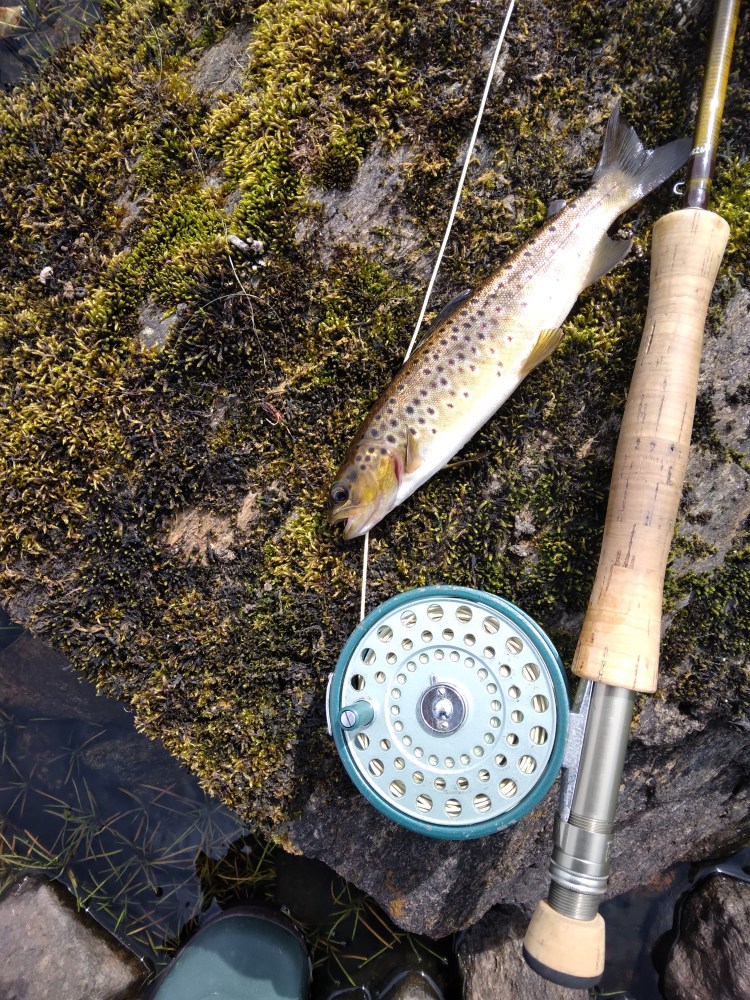
When that last fish came to hand there was some weed on the other flies. Perhaps this weedbed was where the trout were holding? I adjusted my position on the bank so I could fish at a better angle over where the weeds were, using the wind to help me instead of casting against it. Over the next while I rose/pricked/lost a bunch of trout, successfully landing another two in the process. Next I moved over to the bank beside the road and here the action continued, perhaps at a slightly slower pace, but I still had fun rising fish and landing three more, all of them falling for the charms of the Ke-He. I would have happily stayed on the lovely shores of Bunaveela for the rest of the day but I had to get back home and so packed up just after 1pm.

I know many anglers would find this kind of fishing an irrelevance. Big fish is what they want and messing about with tiddlers like those in Bunaveela is not their game. That’s fine, we all seek different ways to enjoy ourselves. There is no right and wrong. It so happens that I love fishing the hill loughs both here in Ireland and back in my homeland of Scotland. Back at home I have to tie up some more Ke-He’s as the one which caught the fish today os looking bedraggled and I can’t see any others in my box. The dressing is the same as for the standard Ke-He except the hackle is from the body feather of a red grouse.

 Claretbumbler
Those trout are the perfect size! They put up the best fights.
LikeLiked by 1 person
Small world, I was only fishing that lough myself 2 nights ago, one of my favorite places. Fish are indeed small but feisty.
LikeLike
Fabulous spot for a couple of hours. It is a sizable lough and I suspect there may be the very occasional big trout in there.
LikeLike
My kind of fishing! I usually use an 8 or 8.5 ft 6 weight for this. Those wild brownies are fantastic fish to catch. Great stuff indeed!
LikeLike
Interesting that you prefer a shorter rod. I was thinking of going for a lighter line weight rod but still over ten feet in length. This is all personal preference of course but do you see an advantage in using the shorter rod on hill loughs? My main reason for a longer rod is to help with clearance of the ground behind me as many Irish loughs have reeds, whins, heather etc close behind.
You are so right about these wild browns, they are amazing fish in so many ways and it is such a privilege to fish for them.
LikeLike
I use a shorter leader with only 2 flies generally and as usually fishing margins a longer cast isn’t essential. That said it’s down to personal preference as you say. A half pound wild brownie on an 8 ft rod can make for great sport though!
LikeLike
It’s been a few years but I’ll leave this comment anyway. Arctic Char are actually quite widespread in Mayo being found in most of the lakes in the Sheefry Mountains in Southwest Mayo and some lakes dotted around Galway and Kerry. There’s also a population in Lough Melvin up North.
LikeLike
Someone told me there were char in lough Tilt too. Had not heard they were still in the loughs up in the Sheefry;s though. I would love to catch just one, but knowing they are in such a precarious position puts me off fishing for them.
LikeLike