
It’s December, and fly tying season is now in full swing for me. The run up to Christmas is usually when I do the bulk of my tying as I try to distract myself from the rampant consumerism around me. To be perfectly honest, due to a total lack of any sort of fishing for the past couple of months I have been whipping and snipping away for weeks now. Just like every other fly tyer I know, and despite the many hundreds of flies in assorted boxes, I still feel the need to make even more patterns. As a way of whiling away the long cold winter nights it seems like a harmless pastime and the rows of new flies in the boxes fires my imagination for the coming season. All this tying has got me thinking about different aspects of my flies and how I tie them. One of the issues which is often in my mind is the size of the fly. Let me explain……
Survey the contents of any Irish lough fisher’s fly boxes and you will be confronted with the usual patterns in the usual sizes. Here we fish patterns tied on normal shank hooks in sizes 10 and 12. Period. Oh there may be the occasional stray size 8 or a misplaced size 14 but the army of foot soldiers will be busked on 10s and 12s. This is of course because they work in that narrow range of sizes. Wild Irish brown trout and sea trout love flies of the gauge and we anglers know that and respond by stocking up on them. Being an incorrigible rebel, I like to mix things up a bit and use a much wider size cohort.
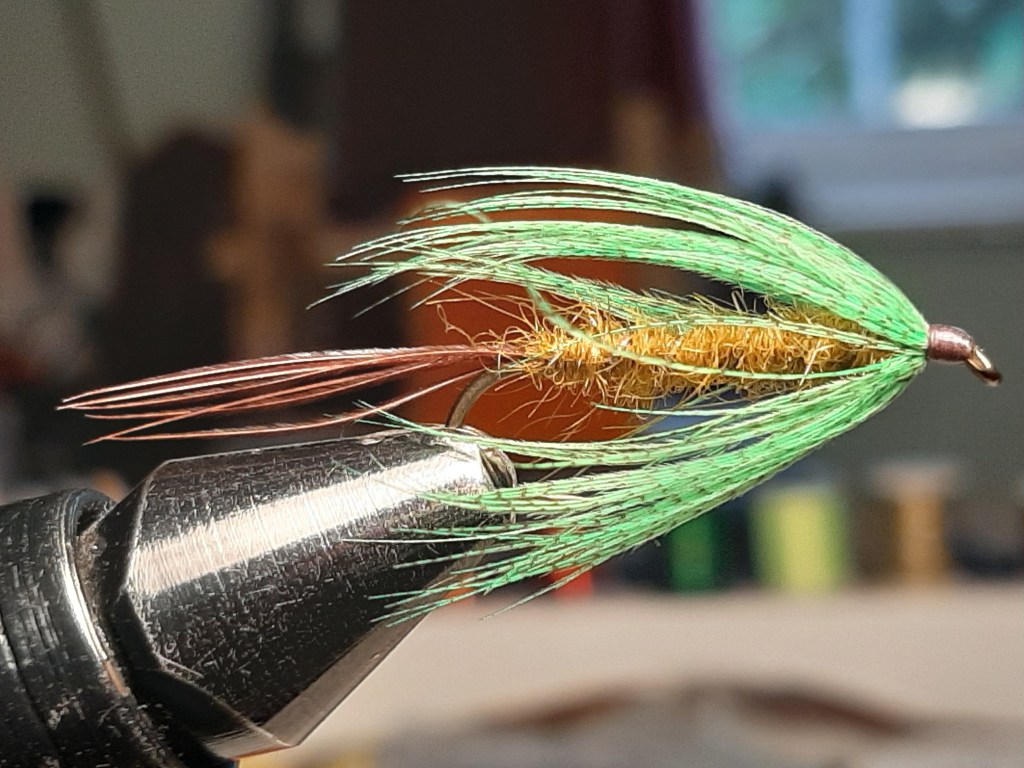
My reasoning for this is that the food which our quarry eats varies so enormously in size, shape, colour and movement. Hence I think we should be more flexible in the sizes of the artificials we hurl at the fish. I know that on the river I fish with flies tied on everything from tiny size 20’s if the fish are on midges right up to articulated two or three inch lures to imitate bait fry or crayfish. By extension, I do the same on the lough where roughly the same rules apply. Yes, I do fish mainly with flies in what could be termed ‘normal’ sizes but much larger or smaller hooks make pretty regular appearances too.
To fish such a wide range of sizes effectively I have to adopt different techniques but for me personally that is a huge attraction and part of the reason I love my lough fishing so much. Just sticking to flicking a dry mayfly five yards in front of a slowly drifting boat or stroking the waves with a team of three wets is wonderful fishing, but I am just as happy pulling a big lure or gently nymphing with tiny flies in the slack water in the lee of an island. How big can you go? Well, I go all the way up to long shank size 6’s some times on my wet fly cast and can recommend these bigger flies, especially from mayfly time onwards.
In the past, a size eight was probably the most common size used on the western loughs. Back 40 or 50 years ago a size ten was considered small and a size twelve thought of as ridiculously tiny. Was that because natural flies were larger then? Or could it be the fish were less ‘educated’? We’ll never know, but it is interesting how fly sizes have reduced over time. I recall reading that trout required big flies to make it worth their while to swim up from the bottom to eat something. It is a nice theory but one which would be very hard to prove. Many, perhaps most, trout on the western loughs are now being tempted on size 12 flies so something has changed.
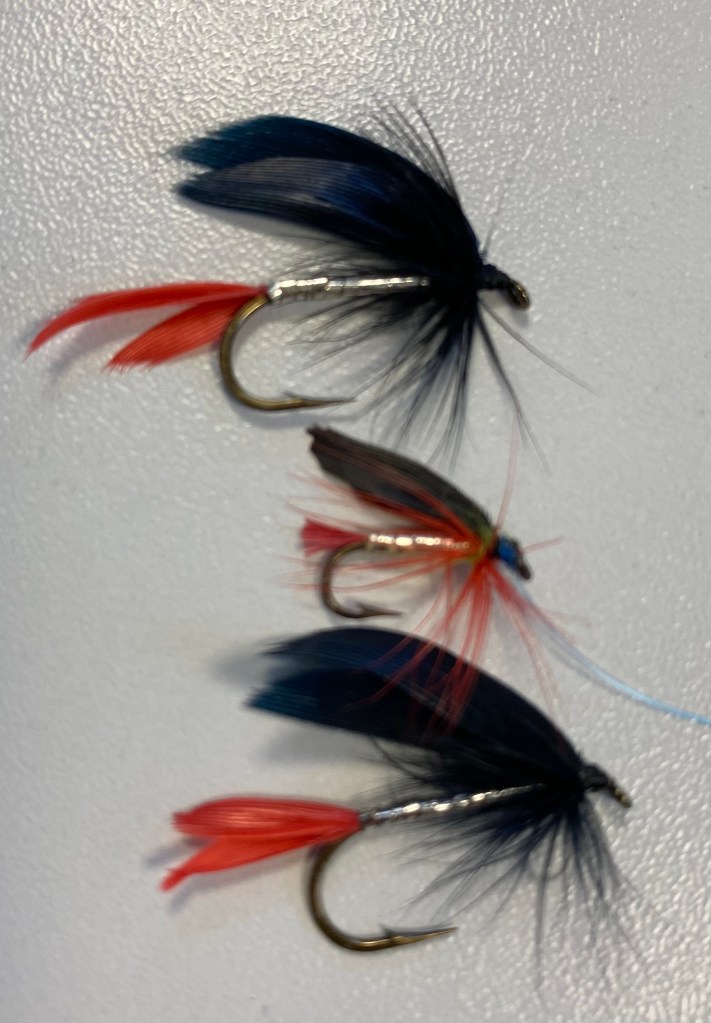
For me, there are some specific patterns which lend themselves to bigger hooks. Murroughs and Peters are obvious candidates and sure enough, I have lots of those style of flies in sizes 6 and 8 for evening fishing. A Butcher, tied on a size 6 hook, is a common choice for me when the fishing is tough. I like a size 8 Fiery Brown, Teal and Black or Bibio fished on a sinking line early in the season. Later on, I like my Mayo Bumbles dressed on a good size 8 for fishing the Rocky Shore on the Mask. Smaller ones just don’t seem to work as well for me.
The contents of my dry mayfly box is a constant source of mirth for my boat partners who say it resembles a flock of budgies as the flies are so big. I don’t care, I like to give the fish a mouthful. When considering matching the size of the mayfly we are confronted with a range of different stages of the fly’s life and variances depending on location. The greendrakes on lough Carra used to be enormous and you needed a suitably large artificial as a copy (I am using the past tense as Carra is all but dead these days). Summer mayflies are smaller than their counterparts who hatch out in the springtime. My biggest dry mays are tied on size 6 long shank hooks while I also use a few wet mays on size 12 hooks. Yes, I still do most of my mayfly fishing with 10’s and 12’s but there is a time and a place for much bigger flies.
Long shank hooks feature a lot in my fly boxes, both wet and dry. My only worry with long shanks is hook quality. I have seen some really poor long shanks, both far too soft or snapping at the bend because the temper is too brittle. I don’t stray past Kamasan B830’s these days and simply do not trust anything else. I tie so many different patterns on L/S hooks I’d be here all day listing them all but I love muddler-headed patterns on long shanks and find them to be really effective for both trout and salmon. There are rows and rows of long shanks in my boxes in sizes 12 up to 6.
The interest in using large lures on sinking lines early in the season sharply divides opinion across the local parishes. Seen by many as little more than the work of scoundrels, others enjoy catching big browns on 3 or 4 inch Humongous (being Scottish, I know these things as ‘Shuggies’) and other such similar creations. I can see both sides to the argument. I have lots of lures in my boxes and occasionally reach for one on a quiet day so I guess I am in the company of said footpads and heathens. I could not go out day after day and dredge the bottom with these huge creations but for a change I do a bit of lure dragging. An hour is as much as I could keep this up, as much for the strain it puts on my casting arm as any philosophical concerns.
Even for me there are some limits to the size of fly you can effectively tie on a hook. When that happens I turn to tubes, typically for fry patterns. Tubes were always a large part of my fly collections for salmon fishing in Scotland ranging from tiny plastic mini-tubes right up to big, heavy brass tubes for getting down fast in cold water. Now I just use plastic tubes for Sunray Shadows for the salmon and the same material for some of my fry patterns. I keep these in a range of sizes in a wee box in my bag. They rarely see the light of day but when they are required they can be really good when tossed at fry feeders. I might do a separate post on those specific tyings.
At the other end of the hook spectrum I use flies down to about size 20 or 22 when necessary. I find the step from an 18 down to a 20 or smaller quite intimidating. I use 18’s a lot on the river and am comfortable tying flies of that rather diminutive stature. Somehow a drop to size 20 feels like a huge change and making flies on such small hooks is hard for me. This is simply a function of my now poor eyesight. The smallest flies are saved for those times when the fish are on caenis. Since that tends to be an early morning or late evening hatch on our loughs the problem of low light levels combined with tiny flies makes this form of fly fishing a huge challenge for someone of my age. These days I fish with a large ‘sighter’ fly on the leader to give me a better chance of seeing the rise to my fly.
Moving up slightly, fishing small dry sedge patterns is becoming more popular during the summer months. Size 14 and 16 deer hair winged caddis patterns are much in vogue, and again, my fly boxes harbour lots and lots of variations on that theme. These smaller offerings are saved for those days of a corduroy ripple and casting to rising fish. Lovely fishing!
All this messing around with flies of different sizes means I also need to use rods which can handle the differently proportioned occupants of my leaders. My 5 weight comes out when I am fishing light and using smallish dries or nymphs. stepping up to the 6 weight I can handle most situations but the 7 weight is able to do all the tough stuff and chuck a cast of big flies around when necessary. Weather conditions also come into the reckoning too of course, so it can all get a bit confusing at times. A day on the lough in a brisk force 5 wind is best tackled with a 7 weight outfit for example.
Please don’t think I am preaching here. Just because I like fishing with a wide range of flies does not mean I am right. Some anglers fish with only a handful of patterns, or fish only certain parts of a lake. Others fish only dry fly while some prefer to drag the depths. Angling is a broad church where dogma is not welcome. All I am suggesting is that if you are tying up flies this winter that you experiment with different sizes.
For now, I will continue making up flies on all sorts of hook sizes and attempt to reach the holy grail of every fly tyer – every one of my boxes completely full of flies!

 Claretbumbler
Typo on my E.mail address for my last post ____ should have been
Keimar01@hotpoint.co.uk
Regards Keith Woodside
LikeLike
I’ll drop you an email so we are in direct contact. Have a happy Christmas Keith
LikeLike