
A lot of you were just as intrigued as I am about the identity of the indigo blue feathers on a patch of skin which recently came into my possession. The shape of the feathers were nothing like any domestic fowl, so whatever it was it came from the wild. I set about tracking it down by looking through my collection of bird books and with the assistance of Google.
I had thought about the colourful Bee-Eater but the blue on those pretty birds is far to light, so they were crossed off the list.
Maybe the Indian Roller was a candidate? They have a lot of blue in their plumage but again, not of the shade I see on the cape. I actually have some feathers from a Roller which I picked up at an Irish fly fair some years ago so I made a quick comparison. No, they were nothing like each other.
Less exotic, I did very briefly look at photos of cormorants and shags, my rational being they both exhibit a colourful sheen on their feathers in certain light. Close examination quickly dispelled those ideas as the sheen on cormorants is very subtle, my cape was pretty damn blue!
How about the Magpie? They are blackish on the nape so could this be the answer? I have handled Magpies in the past and the cape was simply too big to come from bird. Also, the black on a Magpie’s neck is dull and not iridescent like the colour on its wings and tail.
I then back-tracked, could this just be a peacock neck after all? I got a peacock neck feather out of my collection of hackles and laid it on the capes. The two are completely different, there is no way my new cape comes from a peacock.
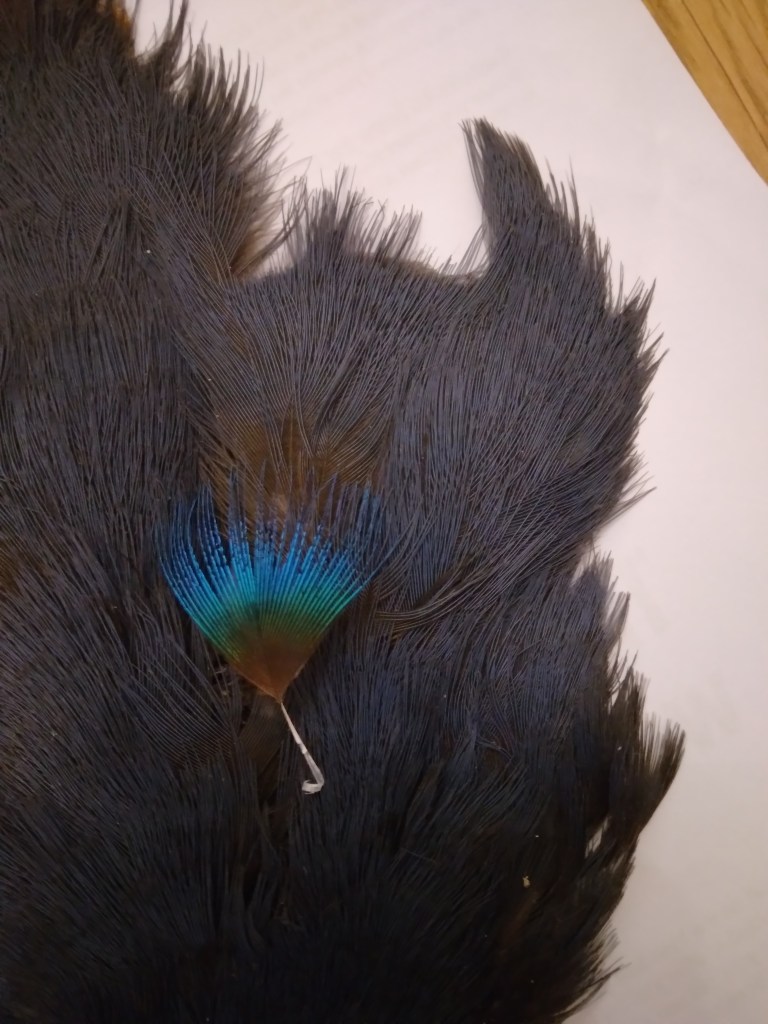
And so it dragged on and on, this search through all the blue coloured birds in the known world. Various blue warblers (too small), American Blue Jay (to light and the feathers are barred), blue macaws (too bright)……………
I searched and searched, peering at photos of birds I have never even heard of but I was still not sure about the cape. To my eyes, the closest in colour I had seen are the feathers on the back of a Black Crowned Night Heron, but I was not convinced. These herons sport iridescent blue/black feathers on their back. Fairly common across a wide range, it is just possible one was shot many years ago and the skin sent for use making flies. It was close, but I doubted the Heron was the right bird, the shape of the feathers looked to be different. I was beginning to fear that unless I made the acquaintance of an ornithologist I will never be 100% sure what they are.
Then I got a reply to my last post from cloudman1130. He first suggested I look at a bird called the blue eared pheasant, so I tapped that into the search engine. Apparently, they are native to the mountainous forests of central China (which goes some to to explaining why I have never seen one before). Unusually for pheasants, the males and females are the same colour.
But cloudman1130 was not finished there, he then sent me a link to photos of a melanistic pheasant. Now I have seen a few of these over the years and none of them were that ‘blue’. The photos showed some very deep blue coloured cock pheasants which looked very close to the feathers I have. But there was a problem – the neck feathers on a cock pheasant are much, much smaller.
I am pretty sure that the mystery bird is a blue eared pheasant after all. Colour and shape look to be very, very close and given I have handled melanistic pheasants before I can rule them out. Thank you cloudman1130. My next job was to make a few flies.
I do like a touch of blue on some of my salmon flies so I started out by adding one of the mysterious feathers as a head hackle on a Clan Chief. The blue is very subtle, much more so than I had anticipated, but I really like the look of the resultant size 8 fly and it will be getting a swim on Carrowmore Lake next season to see if the salmon think the same.

Next up was a Bibio. I know, there is no blue on a Bibio but, once again, the fly looked ‘right’ when the blue feather was wound at the head. This is on a size 10, able to fill a lot of different roles on trout, sea trout or salmon leaders. The blue shade is very muted and you only see it in a certain light, otherwise the long, flowing fibres look sooty.

The ancient indigo cape now sits on my fly tying table and will be used over the next few weeks as I fill my boxes up. They are nice feathers to work with, thin, pliable stems making them easy to double. Thanks to all who suggested birds I should investigate, your help was appreciated.

 Claretbumbler
I’m happy to hear you figured out which bird it was! I have some blue eared pheasant wing quills but they are putty-colored brown. I have never seen a neck from that bird.
LikeLike
Not a bird I was familiar with up until now. Makes you wonder what other feathers are out there we could use.
LikeLike
Glad to have been of help identifying the feathers. Anxious to see the flies you tie with them. Tight lines!
LikeLike
Appreciate the help. I’ll be tying some this week and will post once I have a few made.
LikeLiked by 1 person
While very much an amateur at fly tying I have got more into it recently and intend to tie over the long winter. I like blue on wet flies too, a preference that started with the ubiquitous blue Zulu!
Bumbles and Donegal Blue variants served me very well last year for wild Brownies and a few Sea Trout. All this had me wondering recently ( this is probably a daft question!) but if trout indisputably recognise colours as demonstrated by the success or otherwise of materials used, why are so many fly lines bright and garish in colour? Perhaps it’s simply due to the buffer zone created by leaders and tippets, but is it a factor?
P. S. your flies are like high art compared with some of my efforts and I love the Irish influence on the patterns you tie.
LikeLike
I will write a post my thoughts on fly lines soon. Like you, I have often pondered the pro’s and con’s of different colours.
LikeLike