The current update on my car woes is not good. Still struggling to find the parts for the Yaris and I might need to buy a brand new stub axle. At nearly €500 for a shiny new axle it is a judgement call if I should just ditch the old girl and buy something else. I will decide this week. Until then, it is high time I did a bit of fishing so, taking into account my limited transportation options, I figured I’d try a lake which has had a very chequered past.
Claremorris lies to the south west of Castlebar. It is a busy little place which I often pass through on my way to other angling spots, but have never fished the lakes which lie on the edge of the town. Now there are very good reasons for my lack of enthusiasm for these bodies of water, so let me explain. Clare Lake, the lower of the three lakes, was developed a number of years ago for recreational use. Facilities were constructed which included a car park, a path around the lake and a few timber fishing stands. This has become a very busy spot, popular with dog walkers, joggers and cyclists. The lake used to hold stocks of perch and bream, with some of the bream attaining respectable sizes. The upper lake is called Mayfield Lake (we will class the small pool between them as part of this upper lake), and it was developed more recently and the same level of facilities was provided. These waters held the same species of fish. All good so far? Well no actually. Along side the well known run off pollution, it was common knowledge in the area that both lakes were heavily poached, to the point where catches had diminished to next to nothing. Then things got a whole lot worse.
In April 2024 an effluent leak from Uisce Éireann’s wastewater pumping station flowed into Clare Lake, killing roughly 1,000 fish over a two-week period. On January 7th, 2025 the company pleaded guilty at Castlebar District Court to a water pollution breach and were fined €4,000 plus costs of €7,131. I am not a legal expert but since both Uisce Éireann and the IFI are state bodies this was basically an accounting exercise with one government department giving another government department eleven grand. I’ve read up on the remedial works carried out after the incident and it appears that there was water ingress to the feed lines to the plant, pushing up levels in the receptor tanks and causing it to leak via an overflow pipe. Once the leaks were repaired the flow into the plant were significantly reduced, but the question is why was this not discovered and fixed before the fatal incident. From an angling standpoint, a thousand fish were dead and the fishing in the lower lake was snuffed out.
As a side note, the stream which flows out of Clare Lake drains into the river Robe not far downstream at Castlemacgarret, so any pollution would have quickly found its way into that excellent trout river. The total contempt for the natural world exhibited by Irish government bodies is quire incredible and the fact that pollution incidents like this one are a near daily occurrence across Ireland is a damning inditement of those in charge. Punishments, as you can see from the above, are ludicrously lenient and offer no deterrent to the polluters. I know I am prone to venting my rage on this blog, but it really does boil my piss how polluters escape virtually scot-free in this country. I shall now step off my soap box and continue in a more gentlemanly manner.
Fast forward to today and with limited options for a bit of fishing I thought that I might try out the upper lake to see if there had been any sort of a recovery there. Transport would be courtesy of the local bus service which runs fairly regularly between the two towns. Since I get free bus travel these days I could get there and back at zero expense, something which helped me decide on this trip. Even if (as was likely) I would blank, it was not going to hurt me in the pocket. I consulted the relevant timetables and planned accordingly. Taking fishing tackle on public transport was likely to be fraught, so I scaled everything down to the bare minimum and set an alarm for 6am.
The bus stop is across town, so I set off in good time, my rucksack on my back and an old nylon quiver containing my rods and landing net handle in my hand. And that was it, none of my usual paraphernalia made the cut, just what I could comfortably carry and nothing else. My rucksack/stool contained a small box of end tackle, some pre-tied rigs and hook lengths, a couple of reels and some maggots. Food and drink was stuffed into my jacket pockets. Dressed in hiking boots, waterproofs and a warm hat, while greatly adding to my comfort, made me look a right wally at the bus stop, but I am long past caring what others think of me and how I look. This was not Milan fashion week, just an old guy off to chuck some maggots into an Irish lake for a few hours.
A cool, breezy morning greeted me as I left the house but at least it was dry. Rain was forecast for the late morning but if I could get there and be set up before the wet weather arrived I would be happy. A few minutes spent waiting for the bus to arrive was chilly but I was soon on board the warm bus, bag and quiver stored safely in the luggage compartment. I have recently used my bus pass a few times and I have to say that Irish buses are OK. Not brilliant, but certainly not awful either. They are generally clean and punctual, and my only real gripe is the frequency of them. We are constantly bombarded by the government here to ditch the car and use public transport, but that is very difficult here in the west where buses and trains are few and far between.
On the journey down to Claremorris I pondered the day ahead. With the stock of older fish decimated two years ago, I was banking on there being some small skimmers and tiny perch to be the inhabitants of the lakes. Perhaps some fish in the far end of the Mayfield Lake had escaped the worst effects of the spill, so there just might be one or two better bream still in there. At this stage though, with no fishing for weeks, I just needed to get out in the fresh air for a few hours. To catch a few small skimmers would be a bonus. The bus I was on had started its journey in Ballina and was headed for Galway city, meaning it was pretty crowded with the usual mix of students and old fogies like me availing of their free bus pass. The bus let me off at the stop on Dalton Street outside the leisure centre from where it was a 15 minute walk to the entrance of the park. From there I walked along the path on the west side of Mayfield lake looking for the fishing stands I knew were somewhere in the reeds.
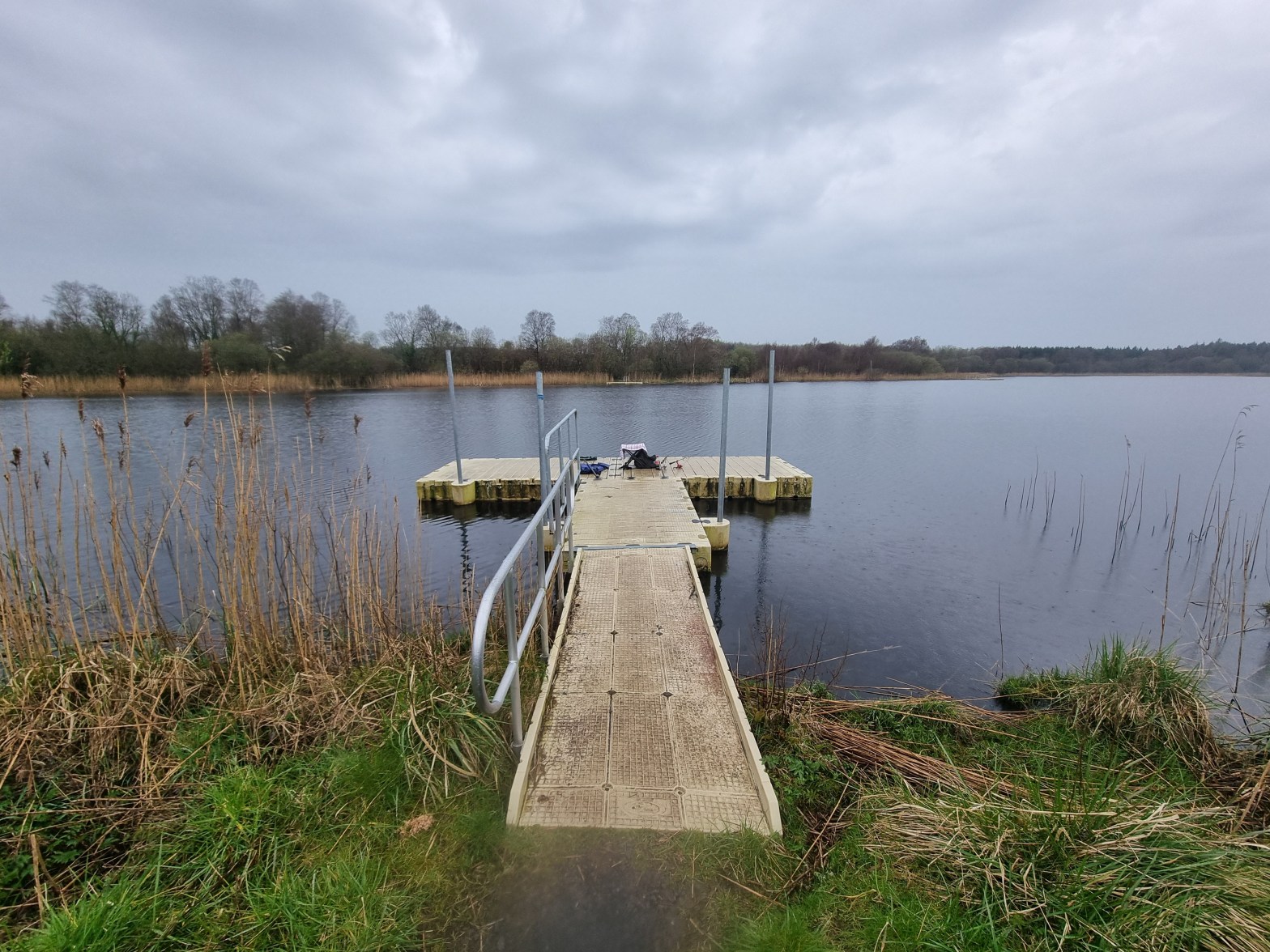
The first stand I came to was on the west side of the smaller, middle lake. This was pretty sheltered and I was tempted to try here first, but then decided that the further away from the site of the pollution was likely to be more promising. I trudged on along the well maintained path until I came to Mayfield lake proper. Four stands, two on the east side and two on the west, presented me with a conundrum, and in the end I plumped for the nearest stand on the west bank. This was pure guess work on my part, I have no local knowledge of these lakes so I could be totally wrong but I had to start somewhere. The stands were all of the same design, plastic floating stands tethered to the bank. Inexpensive and easy to instal, I understand why they were used, but for me they presented a problem. They wobbled underfoot when I stood on them, setting my vertigo off like someone had lit a blue touch paper. Grabbing the hand rail I steadied myself, set up my stool and sat down to let the world stop spinning. Within a few minutes I was OK, but each time I stood up for any reason my balance went heywire.
Tactics would be my normal two rod set up. The old 12 foot, three piece, general purpose coarse rod was pressed into service as a float rod for the day, paired with a 3000 size fixed spool filled with 6 pound mono. I started off with a crystal waggler above a 4 pound hook length and a size 16 hook. The dinky wee 9 foot leger rod with a similar reel and line and a maggot feeder and a size 16 hook was preferred for bottom fishing. It had crossed my mind to bring along a rod for pike fishing, as there were almost certainly a few jacks in the lakes, but that would have entailed dragging more gear with me when I was trying to reduce weight as much as possible.
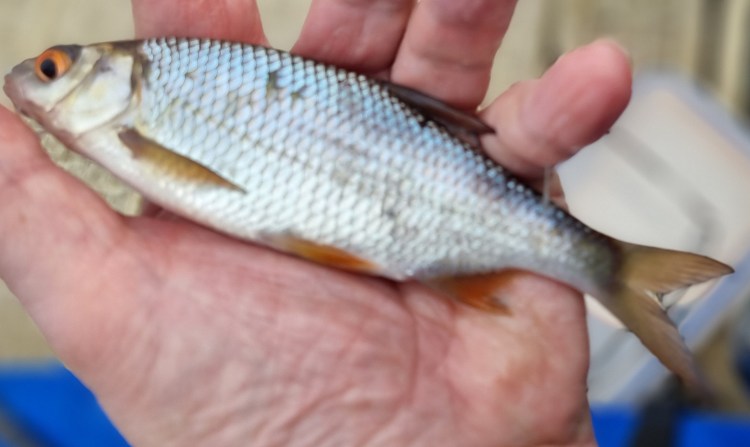
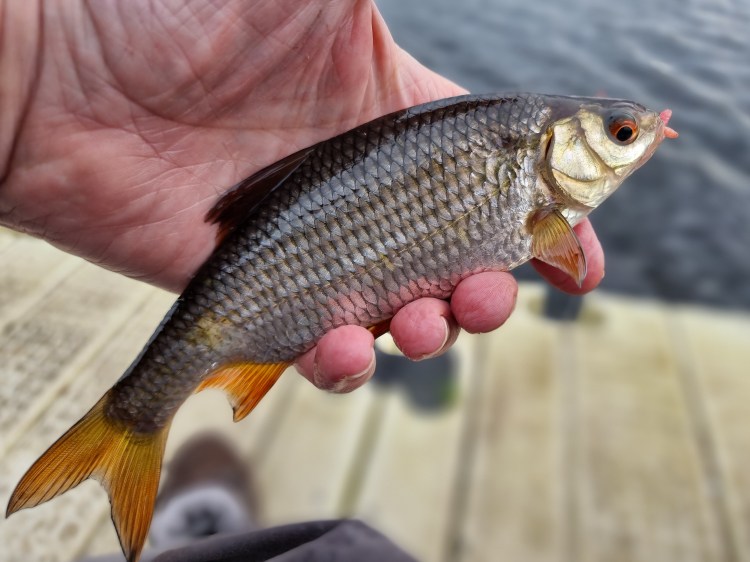
The feeder rod set up and cast out, I was threading the rings on the float rod when there was a bite on the feeder. Already! I reeled in a nice silvery roach, a species which had not been mentioned in any of the literature I had so carefully perused before today. I snapped a quick photo, unconvinced I would catch anymore fish today. Plumbing up I found 11 feet of water just one rod length out and adjusted my float to fish hard on the bottom but not over depth. The steady wind was coming from right to left, small wavelets marching across the pewter surface. A few casts in I had a bite on the float, or at least I think I did. Spotting bites was very difficult in the waves and poor light. I persevered, but this was not easy by any stretch of the imagination. I found myself striking into thin air, losing sight of the float and having the maggots chewed off without seeing any indication on the float. This all sound a bit crap, but I was catching a few fish too. Eight roach, hybrids and perch, none of them big, all fell to the charms of double maggot, but it was terribly hard work. I needed to try something, or somewhere different.
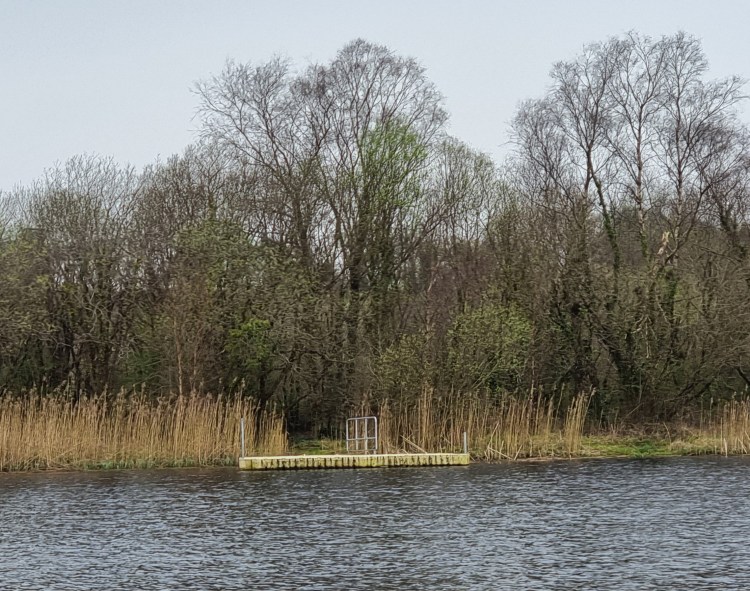
Directly across from where I was fishing was another floating stand. While I had initially thought the wind had been blowing directly up the lake, I now suspected the opposite bank was a bit more sheltered. It was hard to know, but by now I was cold and figured the walk over there would warm me up a bit if nothing else. I packed up and headed over a long timber bridge to the east side of the lake just as the first rain drop fell. More wobbles and dizziness ensued as I set up the float rod and re-plumbed the depth on the precarious plastic stand, then I began to feed a swim two rod lengths out with pinches of maggots. The difference between each side of the lake was obvious, the wind was ever so slightly from behind me meaning the willows on the east side gave shelter and the water in front of me was virtually calm. Slow to start with, the bites came eventually as roach, perch and skimmers came on the feed. The light, misty rain grew heavier until I was fishing in a downpour, but I was too preoccupied to pay much attention to the increasing hydrology. There were one or two positive bites, but in general they were timid affairs which required huge concentration to spot.
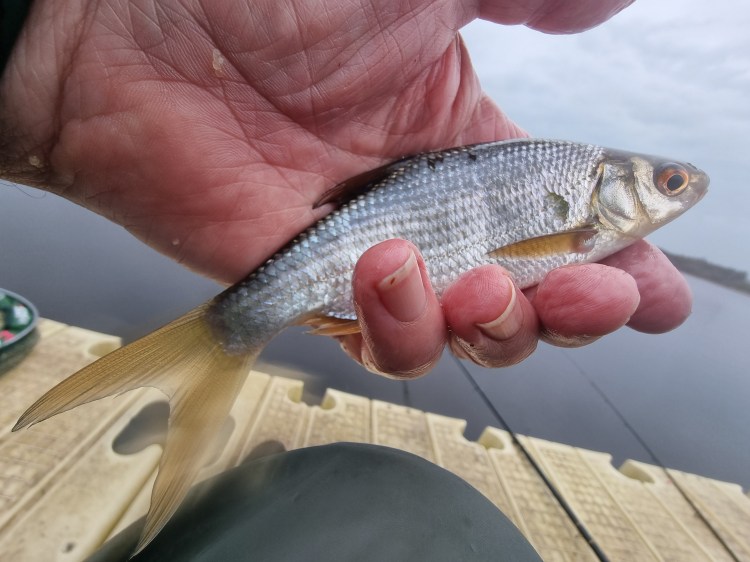
I trickled maggots in as loose feed and the fish held steady in the swim. Nothing big came to the net but one line bite resulted in the hook coming back decorated with a scale the size of my finger nail, so there are some bigger fish in there. The best I could manage was a skimmer of around the pound while the best roach would have weighed maybe 10 ounces (but most of them were a lot smaller). My old waterproof trousers were not up to the job and began to leak but I didn’t care, the fish kept biting and the float kept twitching under the low, grey sky. The catch rate was such that I didn’t feel the need to make any adjustments, something that is unusual for me. It was a lovely session. Damp and slightly cold perhaps, but I have fished in much worse and caught a lot less. After such a long time away from the water I could not have asked for a better day.
I packed up around 2pm, stowed every sodden piece of kit away and wobbled off the stand and back on to the path. The slow stroll back into town and subsequent wait in the rain at the bus stop was not onerous, it just seemed to be another damply enjoyable facet of the day. By 4pm I was crossing the threshold at home, divesting myself of layers of sogginess and jumping in a luxurious hot shower. Helen was bemused how, yet again, I could be so happy at getting cold and wet catching little fish which I simply throw back. She made a lovely dinner and we sat up chatting in front of a blazing fire sipping red wine, the perfect end to a rather wonderful day.
What to make of the Claremorris lakes then? My low expectations were obviously surpassed by a considerable margin. I had caught 22 roach, 19 rotund little perch, 6 skimmers and 4 hybrids for a total of 51 fish and while none of them were any size I think there may be a few better ones in Mayfield. The spot where the pollution happened is on the stream which connects Mayfield to Clare and there is a steady flow down that narrow watercourse. That probably means the effluent didn’t penetrate up into Mayfield and the fish up there survived intact. I had brought the bare minimum of tackle and was not able to fish at distance with a feeder, a tactic which would have given me a chance with any larger bream which may still be in there. I am looking forward to returning in the very near future to try some of the other stands and be a bit better organised so I can try different methods and baits.
As someone who had rarely been on a bus before retirement, my experiences on the local buses has been pretty positive. The drivers are helpful, the buses comfortable and warm and they get me from A to B for free. Even when I do get the car back on the road I would be tempted to take the bus to Claremorris and fish the lakes there.
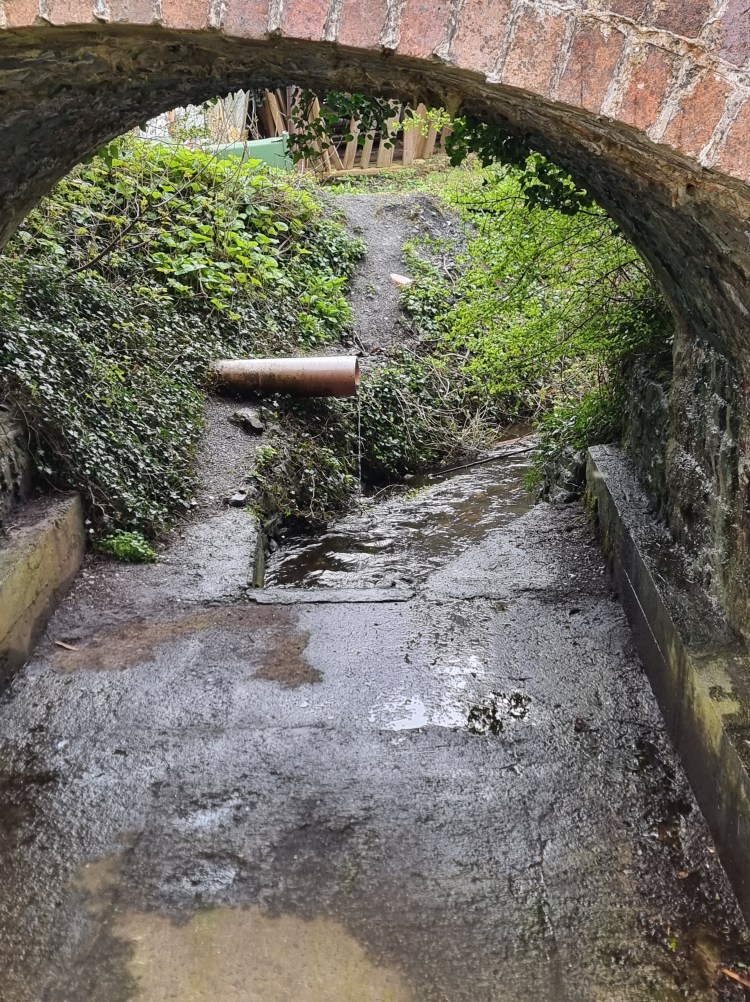
Was this the pipe responsible for the effluent leak? It looks like a surface water drain and it comes out of the WTP.

 Claretbumbler