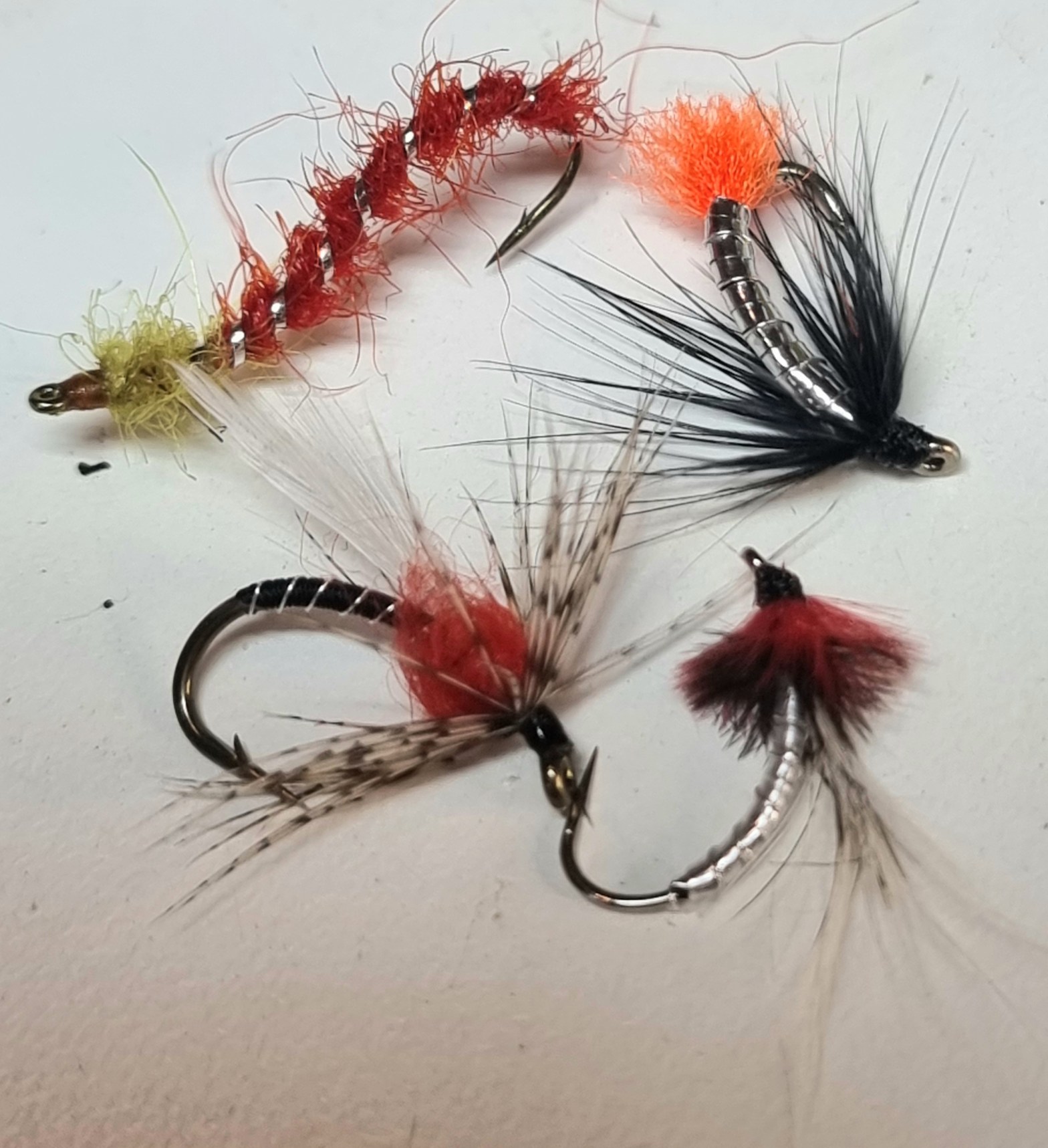
2026 is whizzing past at a frightening rate, meaning the opening of the trout season here in Ireland is not far away. Early in the season, the Irish fly fisher has four main options, namely pulling lures close to the bottom, traditional fly fishing with dark wets targeting fish feeding on hog louse and shrimp, buzzers or the duckfly. Here are some patterns to have in your box to use during the latter hatches.
There is a strong case to just tie any dark fly on your early wet fly cast and the trout may take it as a duckfly. Anything from a Watson’s, Kingsmill, Teal and Black or a Bibio would fall into this category, but a good old Black Pennel would be my favourite. Some patterns don’t fit easily into rigid categories, they can be fished as nymphs or wets, depending on conditions. Let’s take a closer look at four such flies.
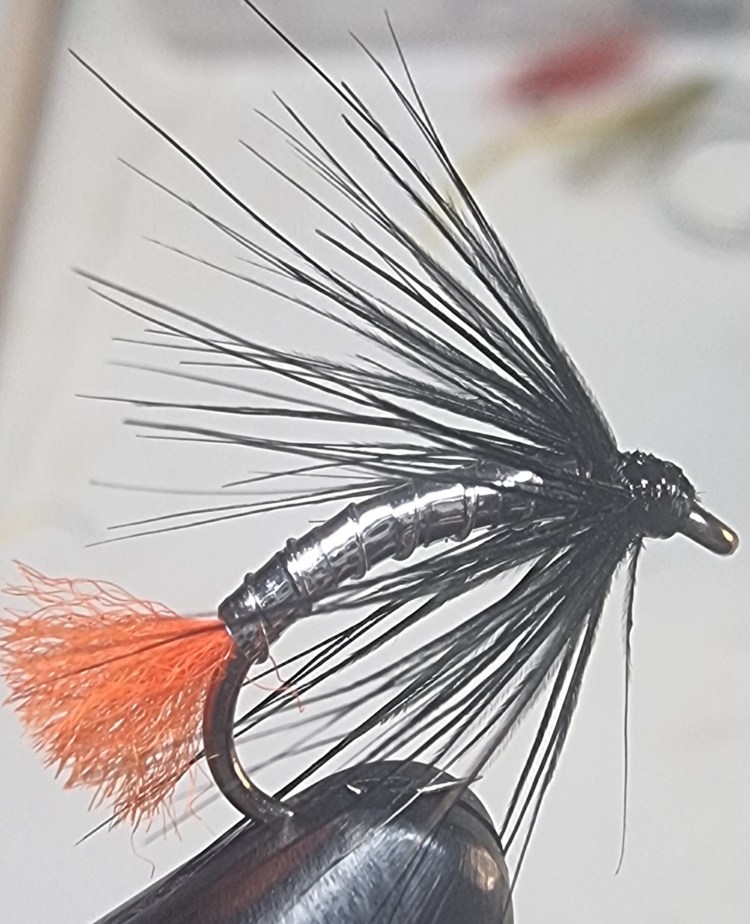
The Silver Spider can be tarted up a bit by adding a fire orange yarn tail and it will work. I tie this one on a Kamasan B110 hook in sizes 10 to 14. Just a silver body with a black hen hackle and the yarn tail.
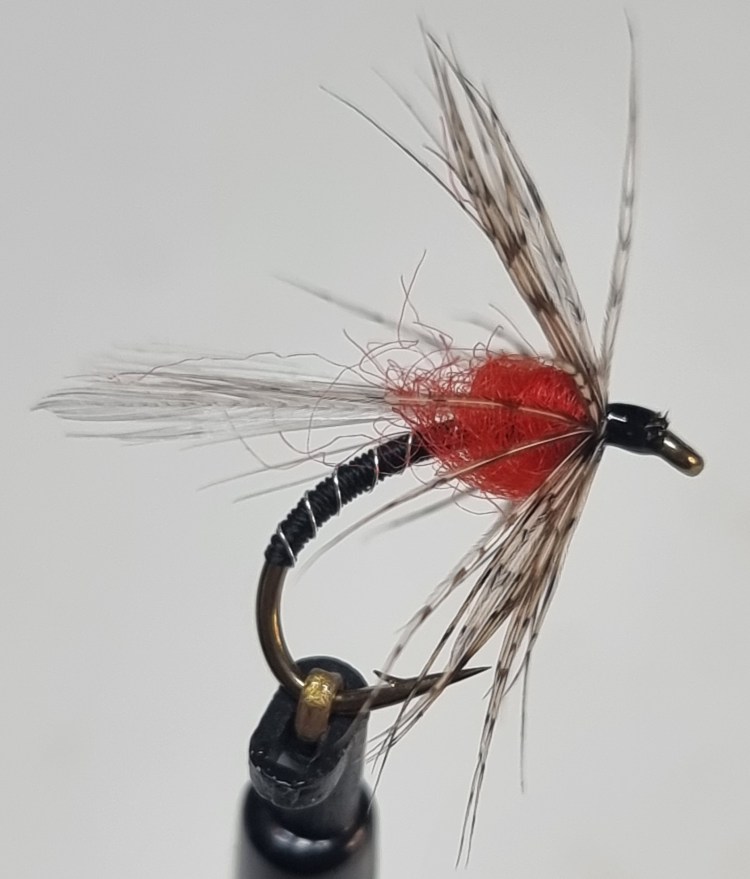
Leonards Duckfly, a pattern designed by Cyril Conlon, used to be hugely popular on the Corrib but I haven’t seen anyone use it for ages. Again, a B110 hook is used, and black tying silk. The abdomen is flat silver tinsel over wound with clear polythene. I add a rib of fine silver wire to give the weak polythene a bit of protection. A short wing made from grey squirrel tail hair is tied in behind the thorax which is made of three turns of black ostrich herl and then three turns of red ostrich herl. The original had a head of red varnish, but I either don’t bother with that or I wind on and whip some GlowBrite no.4 floss instead. Hook sizes are 14 to 10.
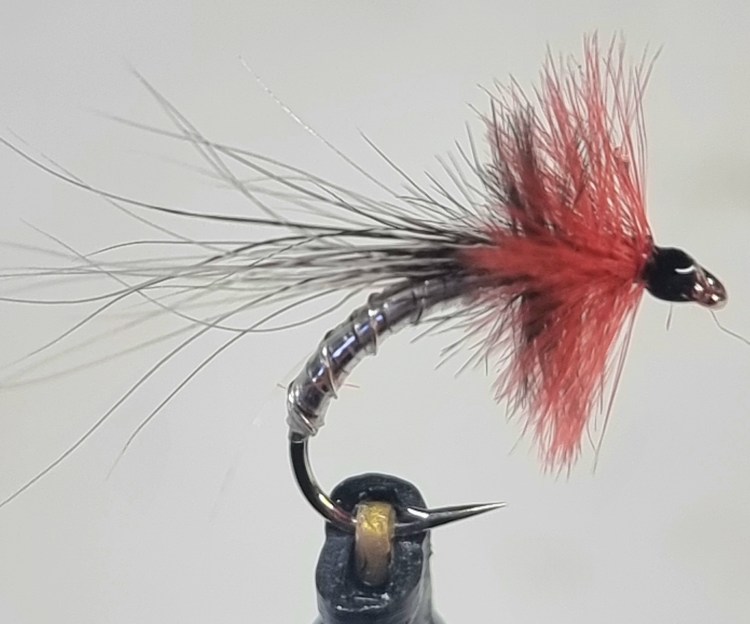
Another of Cyril’s patterns is his Duckfly Emerger Variant. A size 10 or 12 hook (I prefer a curved B110) and black tying silk gets you started. Make the abdomen with the black silk and rib it with fine silver wire. A pair of white cock hackle tips are set in a ‘V’ before dubbing some hot orange seal’s fur to form a thick thorax. Finish off the fly with a brown partridge hackle.
The use of red or orange in duckfly patterns stems from the burst of red as the fly hatches out. Many years ago I was fortunate enough to buy some fine synthetic dubbing from Veniard which is the perfect shade for duckflies. I bought it by accident, Veniard were selling off end of line stock and I purchased a mixed lot of small bags of different colours. To be honest, I was more interested in the brown olive and golden olive ones than the bags of orange/red. Later on though, when tying up some duckfly patterns I remembered the wee bags of fine dubbing and used them on some Palamino Midges. Those Palaminos were great and so I tried the dubbing on other duckfly patterns, with equally good results. In fact, the Duckfly Emerger above was tied with this dubbing.
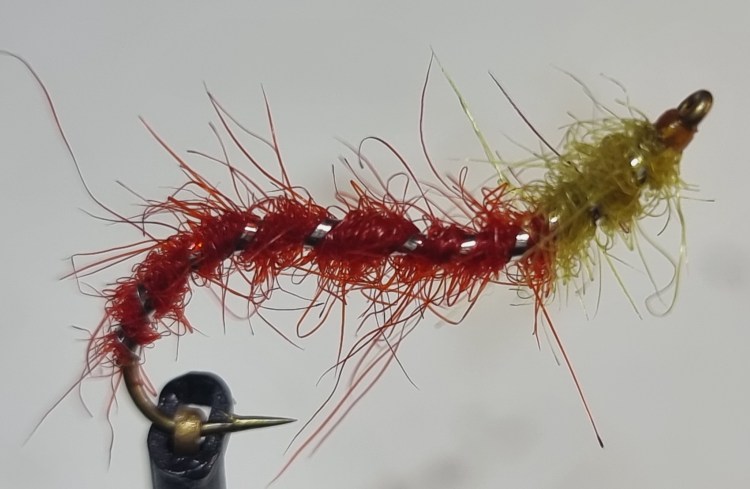
Not really a duckfly I suppose, but this is a bloodworm pattern from lough Sheelin. It was invented by Stuart McTeare and is fished very slowly on a floating or intermediate line. TBH, I have only ever caught one trout on this fly, but I have not used it much. Very simple to tie, use a B830 hook in sizes 8 or 10 and golden olive silk. The rear two thirds of the body is red seal’s fur and the front third is pale olive seal’s fur. The whole lot is ribbed with fine, flat silver tinsel. For this season, I have tied some of these on a Daiichi 1770 swimming nymph hooks.
At times you can see huge swarms of duckfly in the air but not a sign of trout moving. In calm conditions it pays to fish the buzzer, switching to traditional wets if a wave develops. Also, do experiment with fly size, sometimes the fish key on to bigger or smaller naturals. I recommend having size 10 to 14 copies in your box.

 Claretbumbler
I’ve read this great blog for many years. Always very well written. Long may it continue. Tight lines for the new season.
Bill
LikeLike
Hi Bill, many thanks for your kind words and I am glad to hear you enjoy the contents of this humble blog. Hopefully, I’ll be writing a fair bit over the course of the coming season, both trout and coarse fishing. I think my readers must be getting a bit fed up of all the fly tying posts! Tight lines and wet nets to you Bill.
LikeLike