A day of lashing rain outside, a bitingly cold wind hammering the water against the windows and finding every small crack or opening to chill the air inside the house. I lit the fire early, the kindling crackling and spluttering until the flue warmed and the heat began to flow in the kitchen. Too wet and cold for their usual morning frolics in the garden, the cats are lounging around the spots where they know the heat will gather first. With the house beginning to warm up and my daily chores out of the way, I have a few hours to myself now. In lieu of actually fishing I am busy at the vice, initially topping up fly boxes but now just tying whatever I fancy. Strangely, over the course of the past few weeks I have been tying ever smaller and smaller flies. Size 18 and 20 wets and dries for use on my local rivers kept me entertained and as part of this new found fascination with all things tiny I’ve revisited my box of Clyde style patterns. This battered plastic box has seen many summers, many more than I care to think about, and I still fish with Clyde style flies. They are not widely used over here in Ireland but they do work very well on Irish limestone rivers and streams.

As a teenager, one of the first books on fly tying I bought was ‘Clyde style flies’ by John Reid. I still have that book (minus the dust cover which disappeared many moons ago), and I leaf through it from time to time. A slim volume full of no-nonsense advice, John detailed many good nymph, wet and dry patterns. I suspect the book is long out of print but copies can be found on the secondhand market. Skinny bodies tied short, slim wings and hackles consisting of a mere turn of the feather are the hallmark of this style. Many of the wet flies also sport upright wings, a very unusual way of tying them. These patterns were developed over many years by dedicated anglers on the hard fished waters of the Scottish lowlands and borders. Many of them are kissing cousins of north country spiders and there is a big crossover in terms of style and materials. Let’s take a look at some of my preferred dressings.
Hen Blackie. Probably the best known fly, it is fairly typical of the style. Your watchword must be ‘light’. Bodies are thinly wrapped silk or fine dubbing, wings are slender and hackles never more and two turns. Generally I use sizes 16 and 18 for these patterns, never going bigger than a 14. For the Hen Blackie you need waxed yellow Gossamer silk from Pearsall’s. There is no rib but I like to add the tiniest gold tinsel tag at the end of the short body. Wings are paired strips taken from opposing wings of a hen blackbird. These are very hard to source unless, like me, you have owned a cat who brings you presents in the shape of poor wee songbirds. My pair of hen blackbird wings is very old but I still find enough usable feathers to keep making Hen Blackies. The wings are tied in low over the back of the hook and a couple of turns of a small black hen hackle in front of the wings finish off the fly.

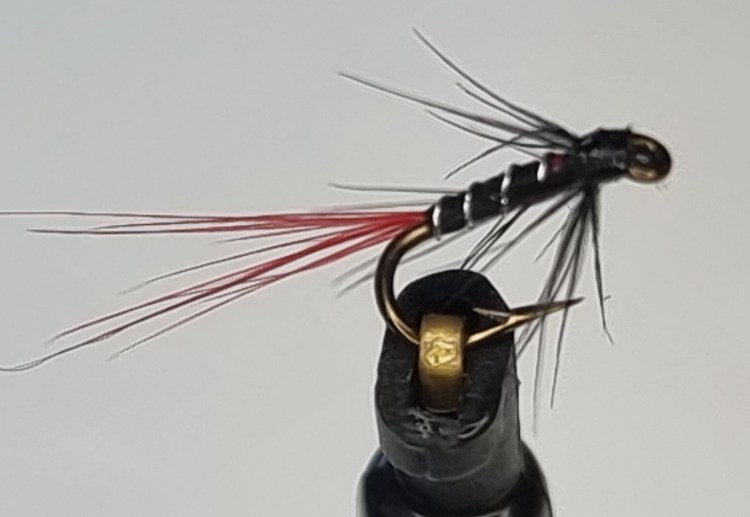
Invented by John Reid himself, the Reid’s Assassin is somewhere in the no-mans-land between an attractor and an imitative pattern. It’s just a wee black spider with finest silver wire rib and a red tail. I have moved on to other, more effective small black flies these days but I still occasionally tie an Assassin on the end of my cast for old times sake. For me, this is a fly which has to be very small, never bigger than an 18.
When there are small sedges on the water in late summer I sometimes fish with a Partridge Tail and Red. A body formed of orange tying silk and a wing made of fibres from the marled tail feather of a partridge which is tied low over the back of the hook. In front, a single turn of a dark reddish ginger hackle finishes the fly. Hook sizes are 16 for normal conditions but moving up to a size 14 for fishing as the light fades

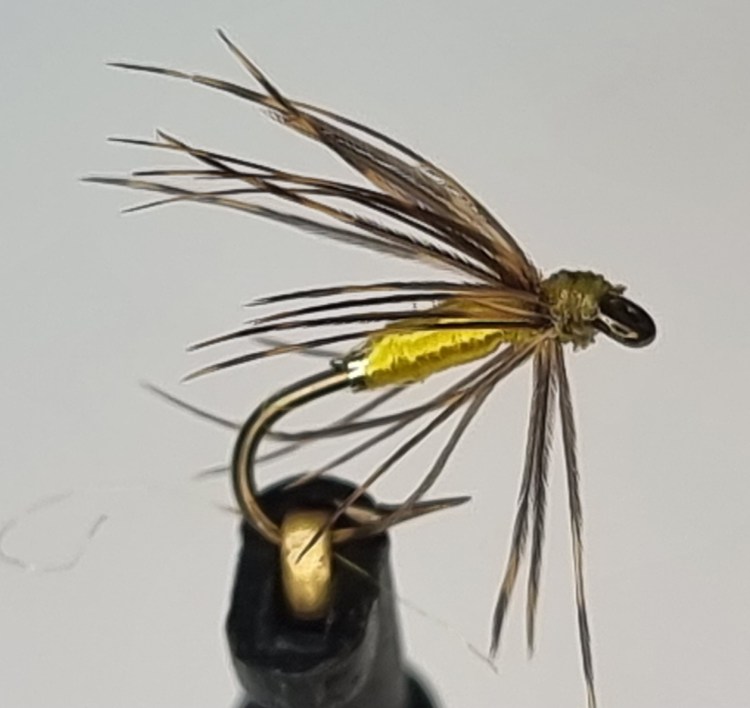
The Grouse Hackle is a simple wee spider for when the summer sun is setting. Tying silk is yellow, the tag on the end of the body is one turn of flat gold tinsel while the body itself is thinly wound yellow floss silk. The hackle is one turn of a tiny speckled feather from the body of a red grouse. These are tricky feathers to wind, being so small and with quite thick stems.
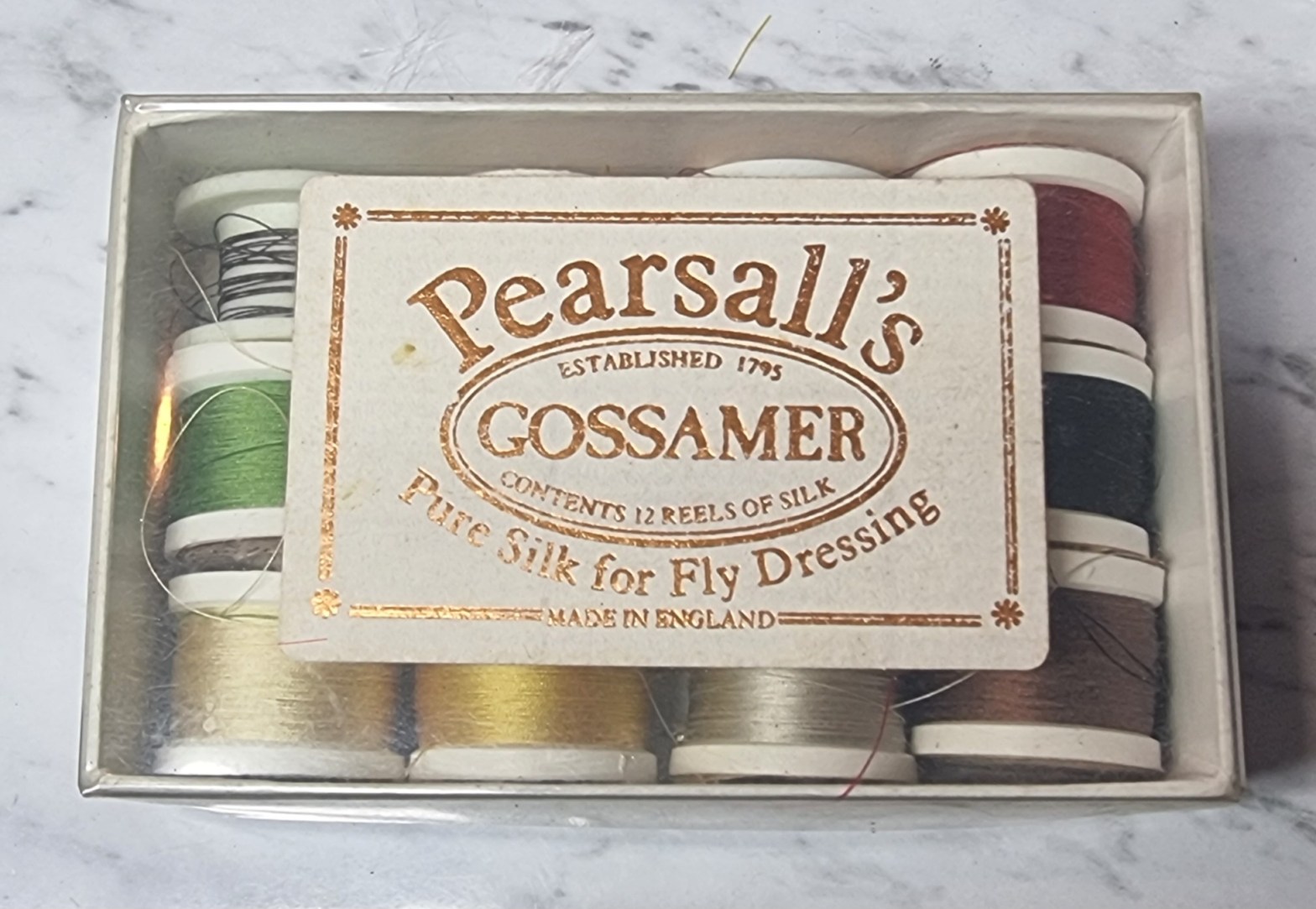
The simplicity of these patterns belies their effectiveness. For me, that minimalism is a big part of the attraction of tying and fishing them. In a world where we are bombarded with the latest complicated killer patterns, requiring the latest hi-tec synthetic materials, there is something very comforting in the minimalist design of Clyde style flies. I like to use the old Pearsall Gossamer tying silks, partly because that is what would have originally been used for many of these flies, but also because the relatively thick and easily broken silk makes me pay attention to each turn. On the small hooks you can’t go wasting multiple wraps of tying silk, there just isn’t room for that. No, each individual turn has to perform a duty, be tensioned just right and positioned with accuracy. I trade big, ugly heads for the joy of using the demanding threads. On a miserably wet and gloomy November day there I find joy in filling a small box with these and many more Clyde styles, simple and deadly but also a link to my past and country of my birth.
Fishing all the wet patterns is akin to spiders, they can be swept down-and-across or fished ‘around the clock’ so you cover all the possible lies. I prefer to fish with two flies on the leader, usually consisting of 3 pound breaking strain. Any heavier the flies won’t fish right, any lighter is risky on the rivers I fish where three pounders and heavier are not unknown. This is lovely fishing, it gets you thinking on how to cast into all the nooks and crannies, feeling for the faintest of tugs or that bronze flash under the surface. A couple of hours spent like this seems to fly past in minutes, such is your level of concentration.

By the way, I am just past the 600 mark for my winter’s tying. I’ll keep tying and start to do a few salmon and sea trout patterns next. I have little faith i will have the chance to use them next season but they are fun to tie regardless. Anyway, the salmon and seatrout boxes have been ignored for a long time and I can weed out any rusty or damaged flies and have them replaced.

 Claretbumbler
That was very interesting the world of fly tying is fascinating, if I had my time again….. I didn’t realise thre was Clyde style flies. Many years ago I was living in South Lanarkshire where the upper reaches of the Clyde ran close by. I can remember local trout anglers speaking of Tench being present in the deep pools, a complete mystery as to how they came to be there
LikeLike
Hi Andrew, The Clyde system seems to be the northern limit for tench in the UK. There are some in the Forth-Clyde canal. For a while back in the early 200’s I lived in Glasgow and the canal was on my doorstep, but back then I had no interest in coarse fishing. Indeed, I used to walk my dog along the towpath for miles every day and yet it never occurred to me to try fishing with float or feeder. Talk about a missed opportunity!
LikeLike
I’ve promised myself I’ll do more spider fishing the coming season. I may tie up a few Clyde style flies to go with the usual North Country patterns.
LikeLike