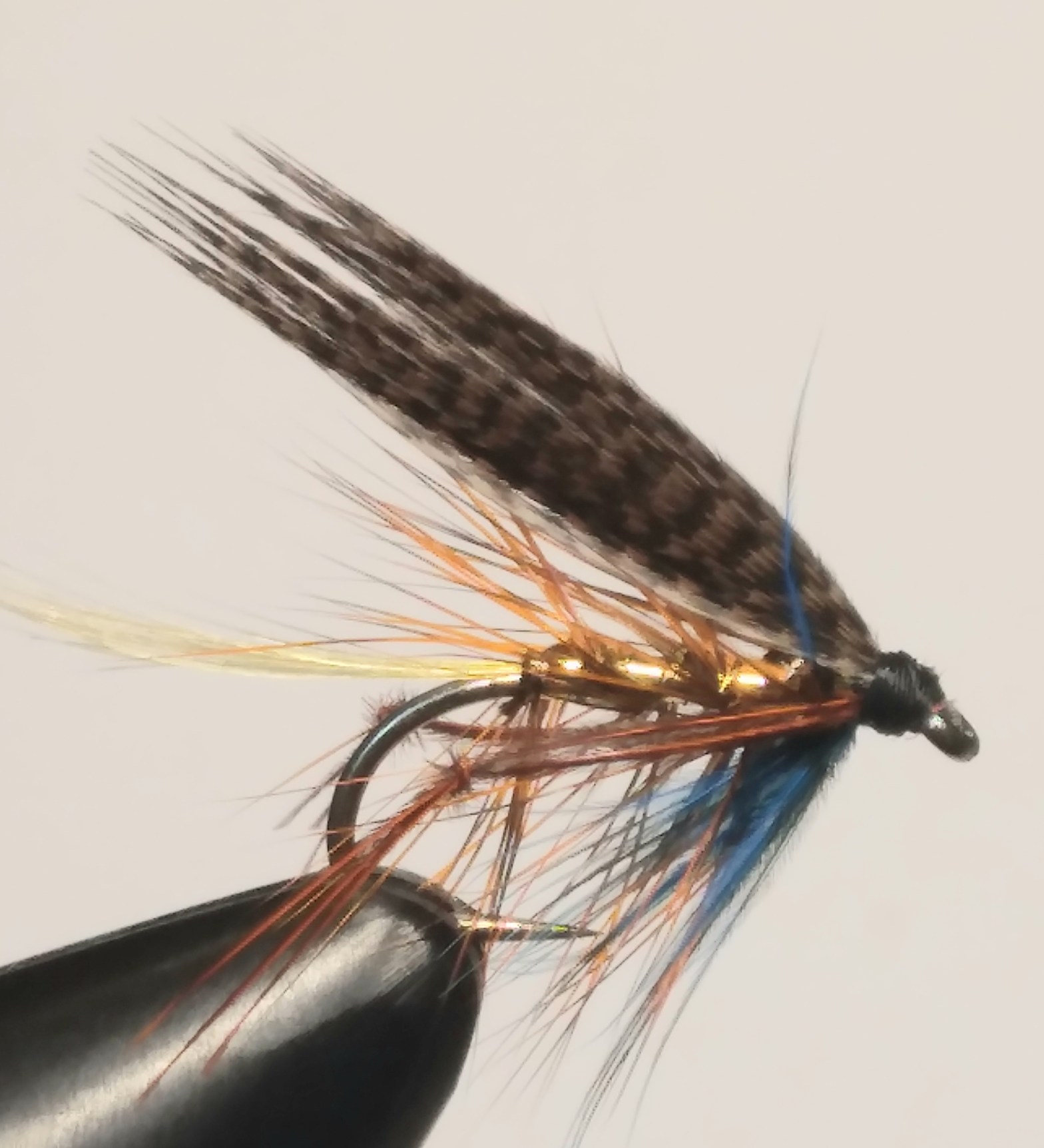
The Dunkeld, in various guises, has always been one of my favourite flies. A long time ago, when I was a kid just starting out on my angling career, I bought a small cellophane packet of cock hackles which were dyed orange for the princely sum of fifteen pence from Somers tackle shop which was then in Thistle Street in Aberdeen. I expended this big chunk of my pocket money expressly so I could make Dunkelds, which I had been reading about in one of Tom Stewart’s books. I had a couple of bronze mallard feathers and some golden pheasant toppings plus the metal gold tinsel and wire, so I was almost there as far as the other materials were concerned. This was one of my earliest attempts at palmering a hackle, a technique which took me a while to master. I can still recall tying that fly and the way the bright orange hackle fibres splayed out as I wound it down the shank. That tricky manoeuvre to trap the tip of the wound hackle with the wire followed by counter winding back up to the eye had my heart in my mouth. Once finished, I felt that Dunkeld the best fly I had tied up until then.
Since then I must have tied hundreds of Dunkelds, from tiny wee ones on size 14 and 16 hooks, all the way up to those busked on japanned irons to try and tempt a salmon. Three olive green brownies from Loch Leven one May evening, a four pound sea trout that ran me ragged on the lower Dee, two brace of finnock winkled out of a fast run on the Beauly – these and many, many more happy memories were created by the orange and gold Dunkeld. Even now, after a lifetime of casting flies to normally indifferent fish, the good old Dunkeld often gets knotted on the end of my leader. And it still works.
The fly I am about to describe has a near mythical reputation for me. It is generally utterly useless, taking up space on a trout leader when other much more worthy flies lie in serried rows within my fly box. Yet, there are times when it is nothing short of lethal. It’s just your common or garden Dunkeld but with a couple of additions.
The hook is always a heavy wet fly hook in a size 10. Tying silk is 8/0 in black. For a tail I use a topping and while you are tying that in, catch a length of gold wire which will be used for the rib. Flat gold tinsel forms the body. Now we get to the changes from the original. The body hackle is a grizzle hackle which has been dyed hot orange. A beard hackle of guinea fowl dyed blue sits under the chin of the fly and on either side are legs made from knotted cock pheasant tail which has also been dyed orange. Finish off with wings of bronze mallard.

As you can see, this is and easy fly to tie. There is nothing in the style of dressing to concern all but the most raw of beginners. Incidentally, I also make it with a blue muddler head and have had great success when fishing for rainbows with the deer hair headed derivative. I tend to fish these patterns on a fast glass or full sinker and like to keep the fly moving at a fair old clip. There are plenty of other Dunkeld variants lurking in my fly boxes, but I’ll save them for another post.
You are not going to believe this, but I just had a search through my huge collection of fly tying gear and guess what? I still have that cellophane packet I bought in Aberdeen as a kid! Not much left in it now but at least it shows what a tight git I am.


 Claretbumbler