
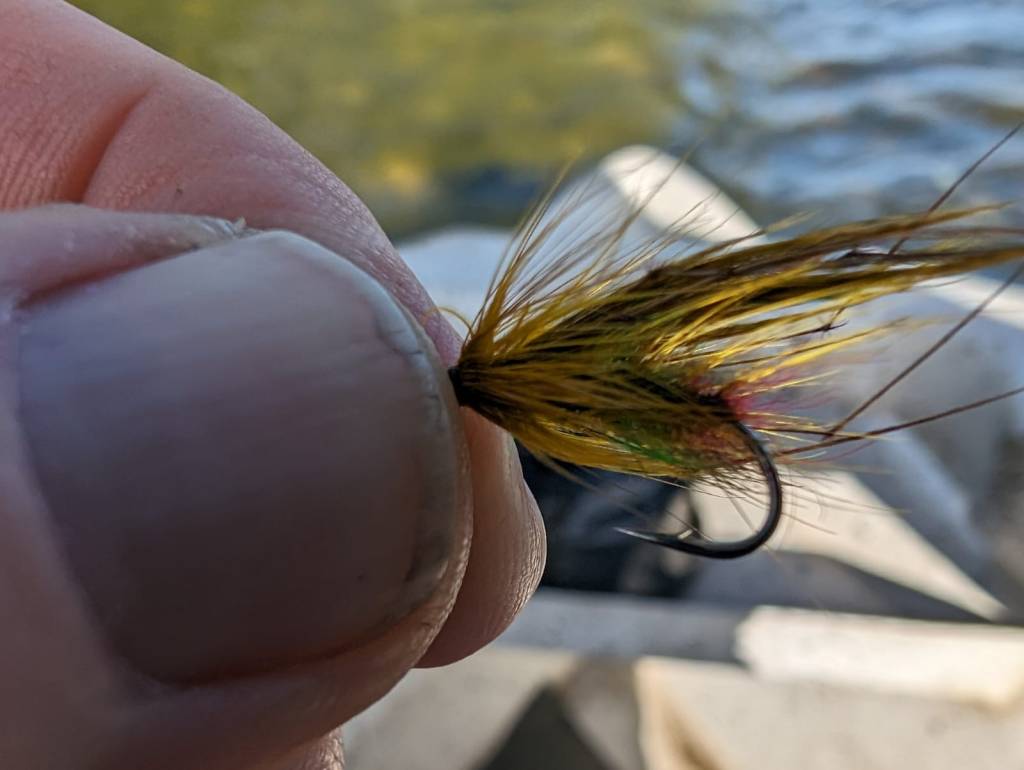
A good friend and regular client, Derek Woods is down in Patagonia at the moment dong a bit of trout fishing. He sent me some snaps of the action down there and it looks like he is having a whale of a time in the 32 degrees heat. Strangely, his most productive fly is one of my Yellow Green Peter’s which I must have given to him when he was fishing Mask. Little did I think this odd little fly would prove attractive to feisty rainbows on the other side of the world.
It just goes to show how versatile Irish style lough flies are. I think there is a tendency to see them only as good for a rolling wave on the Irish lakes but that does these patterns a disservice in my opinion. English reservoir anglers have found them effective as have the lads north of the border fishing Scottish lochs. The cross-fertilisation of ideas has seen UK patterns travel to Eire where they have either become standards here or been used as a profile for some useful variations.
I wonder if the Argentinian trout are taking the YGP as a copy of a local natural or if it is just being fished as an out and out attractor? I tied this fly not to imitate a sedge but as a fly for the mayfly hatch here in the west of Ireland. It has proved to be a reliable pattern that has landed me and my clients a good few trout over the years. It also works for se trout so there must be something about the pattern which excites most species of trout. My original dressing didn’t have any legs but once I added a pair on each side the Irish trout seemed to take more notice of it. You can see from the photo above that Derek was using the leggy version.
Derek’s success in Argentina has got me thinking about where else my flies might have been used. Anglers for many European countries, USA and Australia have all gone off with some of my flies in their boxes so I guess some of them must have been given a trial in distance waters. I’d love to know if any of those well travelled flies caught in distant lands.
I suppose I had better pass on the dressing of my Yellow Green Peter. The shade of yellow is very important, you want a dull sort of yellow colour, not too bright. That way the hackles blend in with the colour of the wings.
Hook: 10 or 12 wet fly hook, a Kamasan B175 for example
Tying silk: Yellow or olive, 8/0
Rib: fine oval gold tinsel
Butt: light claret fur, not too big
Body: light green fur made by mixing some pale olive and medium green together
Body hackle: a grizzle cock hackle dyed naples yellow
Wings: Hen pheasant tail dyed yellow
Head Hackle: another grizzle cock hackle dyed naples yellow, this one a bit longer in fibre
I’ll make a final bust at the fly tying over the next couple of weeks but after that my attention will turn to actually getting out with rod and line for a change. Lengthening days mean I can squeeze in a brief one hour session after work some days on the canals close to work. OK, so it is only a bit of maggot drowning but I can’t wait to kick of my angling for 2024. At this time of year the roach are in no great hurry to grab the bait and I’m not anticipating hectic action. As for fly fishing, it will probably be one or two sessions on the river Robe or maybe joining other lads on Conn or Cullin. Neither are noted early fisheries but you can usually find some feeding trout. Local salmon anglers have been hurling spoons and baits into various parts of the Moy system but I have not heard of any springers yet.

 Claretbumbler