
Known to most anglers as the yelllow owl, I still call those small, brown caddis with an abdomen the colour of lemon curd by their Scottish soliloquy. Curlybums were a great favourite on Loch Leven many years ago, and indeed they may still be for all I know. Summer evenings were when these flies hatched and woe betide the angler without a pattern to match. When I fished the loch forty odd years ago there was no such thing as fancy curved hooks or CDC, so the Yellow Owl was tied as a wet fly. You know what? It caught loads of trout. I particularly liked it tied on a small double hook, either a 14 or a 16 and for that reason tended to tie it on the the end of my leader. Yellow tying silk and wings made from either hen pheasant tail or paired slips from a partridges wings, a yellow floss silk boy ribbed with thick black thread and both the hackle and tails from brown partridge hackles were all that was required.
A similar pattern was the Yellow Professor. Body and rib were as above but the wings were fashioned from the softly barred feather of a mallards flank, while hackle and wings were ginger cock. This should not be confused with that old fly the Professor which had a red swan tail and oval gold rib, but was otherwise the same as the Yellow Professor. I would suggest that few, if any, anglers still use either of these old stagers now. It’s a shame as they are lovely flies to tie and fish with.
These days, more accurate imitations of the yellow owl are to be found in most anglers boxes. My own preferred dressing is tied on a size 14 curved hook and I use white 8/0 tying silk. You can use yellow tying silk of course but I think white gives the abdomen a brighter look to it when wet. The abdomen is yellow floss and the rib is thick black cotton thread. I occasionally use brown thread instead, which somehow looks better to me than the traditional black. Run the abdomen as far around the bend of the hook as you dare to give the fly that nice ‘curly’ look to it. Once the abdomen is complete tie in black tying silk and cut off the white.
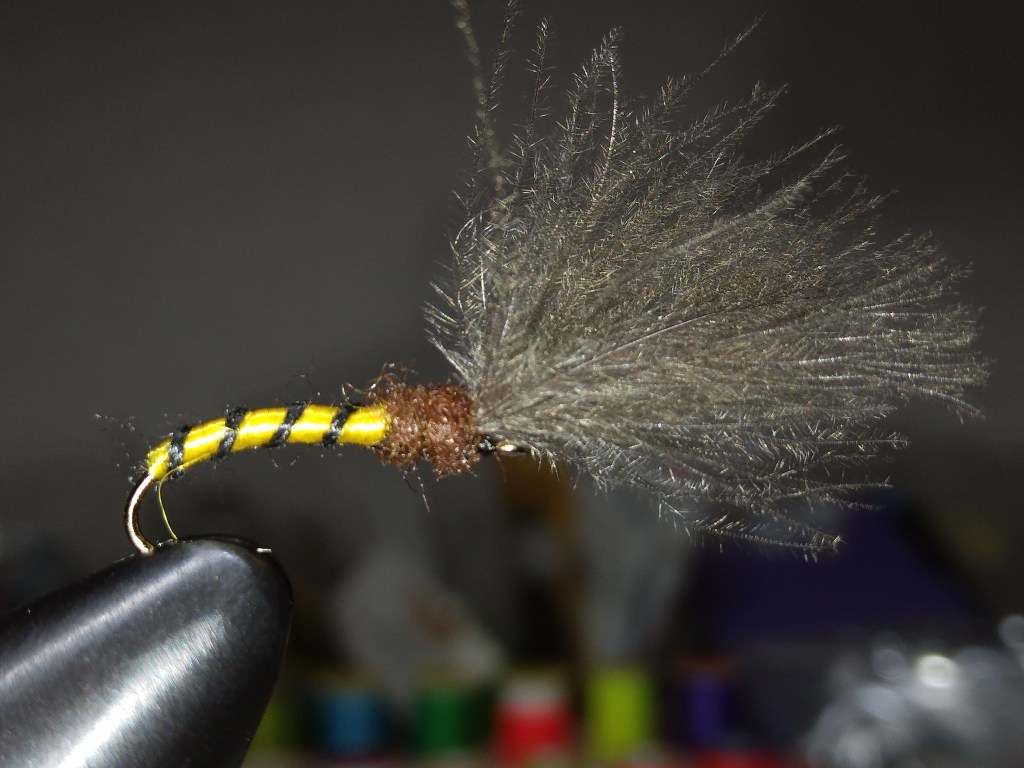
The thorax is brown fur and the cover is made by tying dark brown CDC feathers at the joint of thorax and abdomen, dubbing the thorax then bringing the CDC plumes over the back and tying them in facing forward. A quick whip finish and you are done, it is as simple as that. You can simplify this pattern even further by just tying in the CDC over the eye and dispense with the thorax covers. A size 14 is my usual starting fly but I carry the same pattern but dressed on size 12 hooks in case the wee ones are not working.

 Claretbumbler